Pekka Buttler, 02/2026
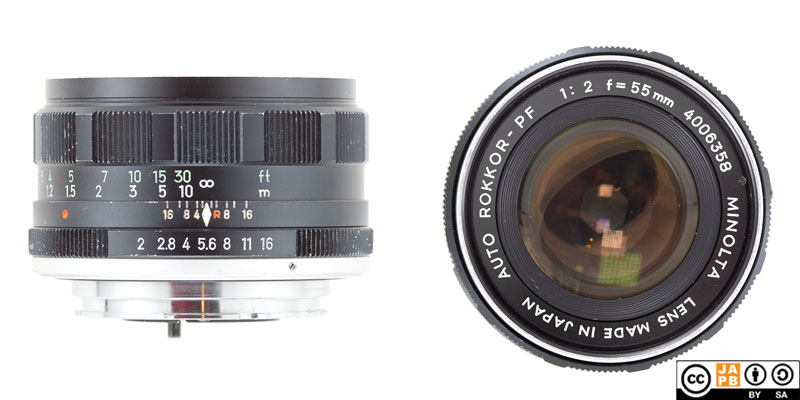
Specifications
The table below summarizes the lens’ key specifications (Measurements based on pictured sample):
| Brand: | Minolta | Lens name | Auto Rokkor-PF 1:2 f=55mm |
| Focal length(s) 1 | 55 mm | Angle-of-view 2 | 43 ° |
| Maximum Aperture | f/2 | In Production | 1967–71 |
| Lens mounts | Minolta SR | Subfamily (if applicable) | ARC |
| Length 3 | 34,8 mm | Diameter 4 | 59,8 mm |
| Filter ring diameter | 52 mm | Weight | 205 grams |
| Lens element count | 6 | Lens group count | 5 |
| Aperture blades (S/R/C) 5 | 6 S | Focus throw | 195 ° |
| Minimum focusing distance (measured) | 49 cms | Maximum magnification (measured) | 1:6,9 |
| Has manual aperture ring | YES | Has Manual focus ring | YES |
| Aperture mechanism type | Automatic | Aperture click stops 6 | 2-2.8-4-5.6-8-11-16 |
Historical notes:
• Had you – at any time before 1973 – asked the designers and engineers at Minolta what they’re understanding of a standard lens’ focal length was, they would not have answered 50 mm. They would have said something like “50 mm for a macro lens, 55 mm for a fast lens, 58 mm for a very fast lens”.
• Indeed. Until the 1973 launch of the 50/2, 50/1.7 and 50/1.4 all Minolta normal lenses sported longer focal lengths. And even then – in 1973 – the f/1.2 superfast fifty was still being made in 58 mm focal length.
• Up until 1973, Minolta was offering four ‘ranges’ of fifties:
• the nifty fifty 55/1.8 designs (1958–66) which were replaced with the 55/1.7 designs (1966–73)
• the budget fifty 55/2 designs (1959–71) which were replaced with the 55/1.9 design (1971–73)
• the fast fifty 58/1.4 designs (1961–73)
• the superfast fifty 58/1.2 designs (1968–78)
Further notes:
• While being the slowest (and cheapest) Minolta standard lens of its age, this lens’ build quality is impeccable and the optical design is based on Tronnier’s 1953 design for the Ultron rangefinder lens.
• This specific sample is one of the last 55/2 lenses to roll off Minolta’s production line before Minolta redesigned the lens and replaced this with the 55/1.9 (see versions)
Versions
The table below summarises the genealogy of the Minolta 55/1.9–55/2 lens.
| Name (on lens) | Variant & Generation | years | min. aperture | elements | groups | filter thread | weight | MFD | notes |
| AUTO ROKKOR-PF | AR I | 1959–61 | f/22 | 6 | 5 | 55 | 260 | 0,5 m | |
| AUTO ROKKOR-PF | AR II | 1961–65 | f/16 | 6 | 5 | 55 | 260 | 0,5 m | |
| AUTO ROKKOR-PF | ARC | 1965–67 | f/16 | 6 | 5 | 52 | 225 | 0,55 m | |
| AUTO ROKKOR-PF | ARC | 1967–71 | f/16 | 6 | 5 | 52 | 205 | 0,5 m | (this lens) |
| MC ROKKOR-PF | MCII | 1971–73 | f/16 | 6 | 5 | 52 | 225 | 0,5 m |
Adapting
This lens cannot be used natively on any current SLR or dSLRs. To use it in its native environment, you will need a Minolta SR (SR/MC/MD/X-600) film camera. Luckily these are quite easy to find. To use the lens’ full designed capabilities, a Minolta MD-compatible body (any Minolta SR body launched after 1977) is most recommended..
Thanks to being a fully manual lens (manual aperture, manual focus), the lens can be adapted to all mirrorless cameras using a suitable adapter. Moreover, a simple ‘dumb adapter’ will do the job perfectly. Thanks to the popularity of the Minolta SR mount, the availability of adapters to all mirrorless mounts can be taken for granted, on the other hand, specialist adapters (speed boosters, helicoid adapters, tilt/shift adapters) are not available for all mirrorless mounts, but daisy-chaining adapters (e.g. Minolta SR -> Canon EF; Canon EF –> mirrorless) can offer a work-around.
Using Minolta SR mount lenses on dSLRs is also be an option, but it is not trouble-free due to that the Minolta SR mount’s flange focal distance is shorter than that of any dSLR mount (technically with the exception of Olympus’ four thirds mount). Hence, any attempt at adapting Minolta SR lenses must rely on an adapter that uses corrective optics to allow infinity focus. However, such adapters are readily available.
History of Minolta
Minolta exited the camera business in 2006 and sold its remaining photographic assets to Sony. The 50 years before that ignominious date tell a very different story: one of a Japanese optics and innovation powerhouse that has interesting links to Germany – not Nazi Germany, but both pre WWII Germany as well as postwar West Germany. Read more in the Minolta company profile.
Footnotes
- Focal length is (unless stated otherwise) given in absolute terms, and not in Full-frame equivalent. For an understanding of whether the lens is wide/tele, see ‘Angle-of-view’. ↩︎
- Picture angle is given in degrees (based on manufacturers’ specs) and concerns the diagonal picture angle. Rule of thumb:
> 90 ° ==> Ultra-wide-angle
70–90 ° ==> Wide-angle
50–70 ° ==> Moderate wide-angle
40–50 ° ==> ‘Standard’ or ‘normal’ lens
20–40 ° ==> Short tele lens
10-20 ° ==> Tele lens
5-10 ° ==> Long tele lens
< 5 ° ==> Ultra-tele lens ↩︎ - Length is given from the mount flange to the front of lens at infinity. ↩︎
- Diameter excludes protrusions such as rabbit ears or stop-down levers. ↩︎
- S=straight; R=rounded; C=(almost)circular at all apertures. ↩︎
- Numbers equal aperture values on aperture ring; • intermediate click; – no intermediate click. ↩︎