Pekka Buttler, 02/2026
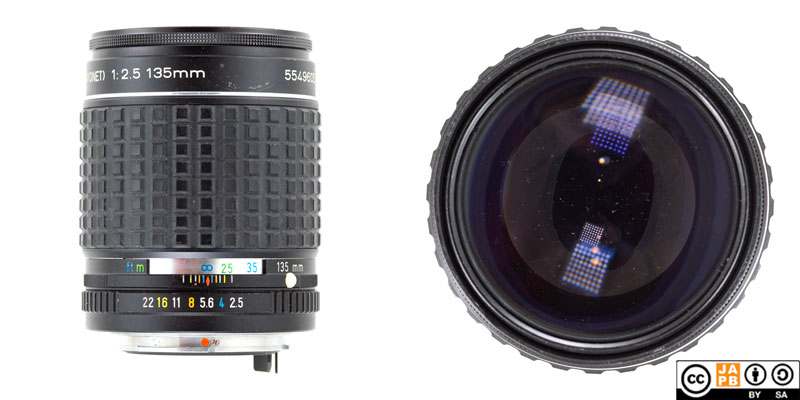
Specifications
The table below summarizes the lens’ key specifications (measurements are based on the pictured sample):
| Brand: | Asahi Opt.Co. (Pentax) | Lens name | Takumar (Bayonet) 1:2.5 135mm |
| Focal length(s) 1 | 135 mm | Angle-of-view 2 | 18 ° |
| Maximum Aperture | f/2.5 | In Production | 1980–1988 |
| Lens mounts | Pentax K | Subfamily (if applicable) | K |
| Length 3 | 78,4 mm | Diameter 4 | 64,0 mm |
| Filter ring diameter | 52 mm | Weight | 387 grams |
| Lens element count | 4 | Lens group count | 4 |
| Aperture blades (S/R/C) 5 | 8 S | Focus throw | unknown |
| Minimum focusing distance (measured) | xx cm | Maximum magnification (measured) | 1:x,x |
| Has manual aperture ring | YES | Has Manual focus ring | YES |
| Aperture mechanism type | Automatic | Aperture click stops 6 | 2.5•4•5.6•8•11•16•22 |
Further notes:
• When Pentax introduced the new bayonet mount (and three cameras and more than two dozen lenses) in 1975, they also introduced the SMC Pentax 135 mm f/2.5 lens. That lens was a direct descendant of the 1972 Super-Multi-Coated Takumar 135/2.5. These lenses feature an elaborate 6 elements in 6 groups design and are generally valued very highly. Importantly, this is not that lens.
• This lens – the Takumar (Bayonet) 135/2.5 – was introduced in 1980 as a budget alternative to the more expensive (and more ambitious) SMC Pentax lens.
• Throughout the 80s and into the mid-90s, Pentax sold a series of budget lenses (mostly zooms, but with a few primes thrown in for good measure) reusing the ‘Takumar’ name7.
• This lens’ design features only 4 elements (in four groups) and lacks Pentax’ signature SMC coatings.
• At the same time it is smaller, 100 grams lighter, has a smaller filter thread (52 mm vs. 58 mm) , a somewhat shorter minimum focusing distance and sports a built-in pull-out hood.
• This lens was produced until 1988. During 1984–1987 Pentax also offered a somewhat slower Takumar Bayonet 135/2.8 alternative.
• The lens’ length elongates considerably while focusing towards MFD, but the filter threads do not rotate.
• This lens is known for having (in terms of legibility) one of the worst focusing distance readouts ever produced. Not only does the ring show metres and feet on the same ring (with metres being coded in green and feet being coded in blue), but both of these colours are on a silver background.
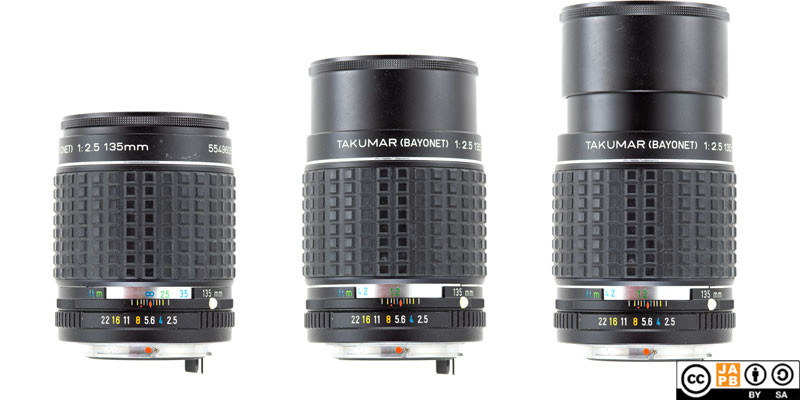
Middle: Takumar (Bayonet) 135/2.5 focused at MFD with hood retracted
Right: Takumar (Bayonet) 135/2.5 focused at MFD with hood extended
Versions
To the best of JAPB knowledge, only one variant of the Takumar (Bayonet) 135 mm f/2.5 was ever made.
However, this lens is by far not the only 135/2.5 ever produced by Asahi/Pentax. Below all Pentax’ various 135/2.5 designs are listed:
| Name (on lens) | Production years | Lens mount | Optical Design | Filter thread | Coating | Weight | MFD | Notes |
|---|---|---|---|---|---|---|---|---|
| Super-Takumar 1:2.5/135 | 1965–71 | M42 | 5e/4g | 58 mm | 444 g | 1,5m | ||
| Super-Multi-Coated TAKUMAR 1:2.5/135 | 1971–72 | Pentax-M428 | 5e/4g | 58 mm | SMC | 449 g | 1,5m | |
| Super-Multi-Coated TAKUMAR 1:2.5/135 | 1972–75 | Pentax-M428 | 6e/6g | 58 mm | SMC | 470 g | 1,5 m | |
| SMC PENTAX 1:2.5/135 | 1975–85 | Pentax K | 6e/6g | 58 mm | SMC | 500 g | 1,5 m | |
| TAKUMAR (BAYONET) 1:2.5 135mm | 1980–88 | Pentax K | 4e/4g | 52 mm | 387 g | 1,2 m | (this lens) |
History of Asahi / Pentax
The camera business today known Pentax was founded in 1919 as Asahi Kogaku Kogyo (Asahi Optical Company). Initially the company manufactured lenses for eyeglasses, later diversifying into projection lenses and even later into photographic lenses, supplying lenses for camera makers such as Konishiroku (Konica) and Molta (Minolta) and binoculars.
In 1952 – the year of the Helsinki olympiad – Asahi released the Asahiflex, the first Japanese 35 mm SLR. Together with its SLR cameras, Asahi introduced a line of lenses that carried the name ‘Takumar’, in honour of the founder’s brother.
In 1975 Asahi/Pentax introduced its own bayonet mount – The Pentax K mount – and phased out the production of m42 lenses and cameras. The name Takumar would remain on Pentax lenses until 1979 (and made some sporadic reappearances). The Pentax K mount is still a current mount, but it has several versions/generations. For details, see the JAPB article on the Pentax K mount.
Pentax was among the handful of Japanese camera manufacturers to keep up with the introduction of autofocus SLR cameras, and even survived the shift from film SLRs to digital SLRs (albeit somewhat struggling).
Adapting
If you want to natively mount this lens you need to find a functioning Pentax K mount SLR (or a dSLR) camera. Luckily that should be relatively easy as Pentax K film bodies were produced in their millions and most of them – especially those manufactured by Pentax – have a good reliability record. Alternatively, you can use this lens on most high-end Pentax dSLRs, but only in stop-down metering mode.
Adapting this lens to a mirrorless, full-frame digital camera is a breeze thanks to the lens having full manual controls (aperture ring, focus ring). You simply need a dumb adapter from Pentax K to your mirrorless system.
Due to the medium flange focal distance used by the m42 mount (45,46 mm), whether you can adapt this lens to other than Pentax’ dSLR mounts depends on which dSLR mount: Canon EF, and Four Thirds can mount Pentax K lenses using a simple adapter ring. Minolta/Sony A and Nikon F on the other hand are not as problem-free, and – to retain anything near infinity focus – the adapter will necessitate corrective optics. In all cases, your camera will work only in stop-down metering.
Footnotes
- Focal length is (unless stated otherwise) given in absolute terms, and not in Full-frame equivalent. For an understanding of whether the lens is wide/tele, see ‘Angle-of-view’. ↩︎
- Picture angle is given in degrees (based on manufacturers’ specs) and concerns the diagonal picture angle. Rule of thumb:
> 90 ° ==> Ultra-wide-angle
70–90 ° ==> Wide-angle
50–70 ° ==> Moderate wide-angle
40–50 ° ==> ‘Standard’ or ‘normal’ lens
20–40 ° ==> Short tele lens
10-20 ° ==> Tele lens
5-10 ° ==> Long tele lens
< 5 ° ==> Ultra-tele lens ↩︎ - Length is given from the mount flange to the front of lens at infinity. ↩︎
- Diameter excludes protrusions such as rabbit ears or stop-down levers. ↩︎
- S=straight; R=rounded; C=(almost)circular at all apertures. ↩︎
- Numbers equal aperture values on aperture ring; • intermediate click; – no intermediate click. ↩︎
- Given that Asahi Optical co. originally adopted the ‘Takumar’ name as a tribute to the painter Takuma Kajiwara (the founder’s brother), the reversal to use the ‘Takumar’ name for a budget line of lenses is somewhat surprising. ↩︎
- With support for open-aperture metering on Pentax Spotmatic F, ES and ESII ↩︎
- With support for open-aperture metering on Pentax Spotmatic F, ES and ESII ↩︎