Pekka Buttler, 01/2026
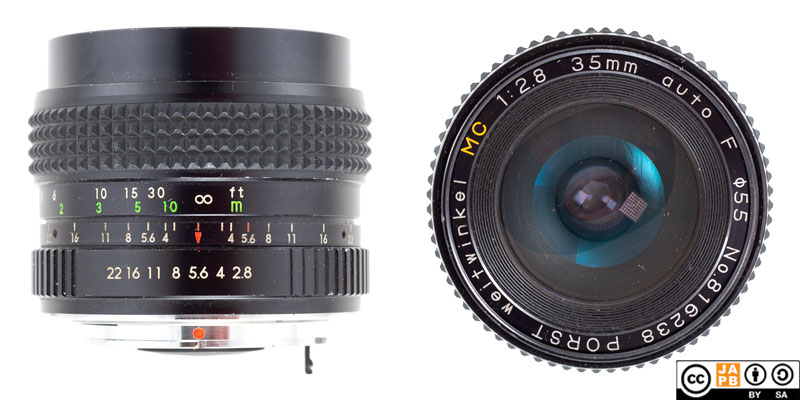
Specifications
The table below summarizes the lens’ key specifications:
| Brand: | Porst | Lens name | Weitwinkel MC 1:2.8 35 mm auto F |
| Focal length 1 | 35 mm | Angle-of-view 2 | 64 ° |
| Maximum Aperture | f/2.8 | In Production | unknown |
| Lens mount | Pentax K | Subfamily (if applicable) | K-type |
| Length 3 | 52,2 mm | Diameter 4 | 63,9 mm |
| Filter ring diameter | 52 mm | Weight | 253 grams |
| Lens element count | unknown | Lens group count | unknown |
| Aperture blades (S/R/C) 5 | 6 S | Focus throw | ≈260 ° |
| Minimum focusing distance (measured) | 53 cm | Maximum magnification (measured) | 1:12,2 |
| Has manual aperture ring | YES | Has Manual focus ring | YES |
| Aperture mechanism type | Automatic | Aperture click stops 6 | 2.8-4•5.6•8•11•16-22 |
Further notes:
• Porst was a retailer/rebrander, and not a lens manufacturer, hence this lens was originally manufactured by a Japanese lens manufacturer. However it is difficult to conclusively identify the origins of this lens7.
• That said, it is clear that Porst was not the only retailer who ended up selling the same product, as this lens was also sold under brands like Avanar, DeJur and Hanimex (only to mention those that I have been able to verify)
• This lens was manufactured at least for M42 and Pentax K mounts, which would indicate that it was a late 1970s lens.
History
See the JAPB company profile on Porst for more information about the company.
Porst sourced its lenses widely. While some of Porst lenses were direct rebrands of identical lenses of major brands, most were sourced from (mostly Japanese) off-brand/OEM manufacturers.
Adapting
If you want to natively mount this lens you need to find a functioning Pentax K mount SLR (or a dSLR) camera. Luckily that should be relatively easy as Pentax K film bodies were produced in their millions and most of them – especially those manufactured by Pentax – have a good reliability record. Alternatively, you can use this lens on most high-end Pentax dSLRs, but only in stop-down metering mode.
Adapting this lens to a mirrorless, full-frame digital camera is a breeze thanks to the lens having full manual controls (aperture ring, focus ring). You simply need a dumb adapter from Pentax K to your mirrorless system.
Due to the medium flange focal distance used by the m42 mount (45,46 mm), whether you can adapt this lens to other than Pentax’ dSLR mounts depends on which dSLR mount: Canon EF, and Four Thirds can mount Pentax K lenses using a simple adapter ring. Minolta/Sony A and Nikon F on the other hand are not as problem-free, and – to retain anything near infinity focus – the adapter will necessitate corrective optics. In all cases, your camera will work only in stop-down metering.
Footnotes
- Focal length is (unless stated otherwise) given in absolute terms, and not in Full-frame equivalent. For an understanding of whether the lens is wide/tele, see ‘Angle-of-view’. ↩︎
- Picture angle is given in degrees and concerns the diagonal picture angle. Rule of thumb:
> 90 ° ==> Ultra-wide-angle
70–90 ° ==> Wide-angle
50–70 ° ==> Moderate wide-angle
40–50 ° ==> ‘Standard’ or ‘normal’ lens
20–40 ° ==> Short tele lens
10-20 ° ==> Tele lens
5-10 ° ==> Long tele lens
< 5 ° ==> Ultra-tele lens ↩︎ - Length is given from the mount flange to the front of lens at infinity. ↩︎
- Diameter excludes protrusions such as rabbit ears or stop-down levers. ↩︎
- S=straight; R=rounded; C=(almost)circular at all apertures. ↩︎
- Numbers equal aperture values on aperture ring; • intermediate click; – no intermediate click.a ↩︎
- The Porst 28 mm f/2.8 WW (Weitwinkel; wide-angle) Macro has considerably similarities with the Sigma 28/2.8 Mini-wide (but also some differences). Another potential candidate is a Cosina 28/2.8 Macro lens, but also the samples of that lens show some differences to this lens. ↩︎