Pekka Buttler, 01/2026
This lens was kindly provided for cataloguing by Vladimir at #photogears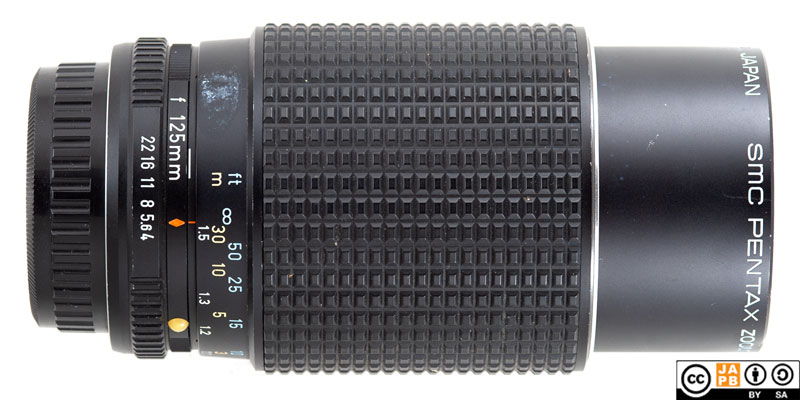
Specifications
The table below summarizes the lens’ key specifications (measurements are based on the pictured sample):
| Brand: | Asahi Opt.Co. (Pentax) | Lens name | smc Pentax Zoom 1:4 45~125 |
| Focal length(s) 1 | 45–125 mm | Angle-of-view 2 | 51 ° – 20 ° |
| Maximum Aperture | f/4 | In Production | 1975–1984 |
| Lens mounts | Pentax K | Subfamily (if applicable) | K |
| Length 3 | 126,5 mm | Diameter 4 | 67,9 mm |
| Filter ring diameter | 58 mm | Weight | 617 grams |
| Lens element count | 14 | Lens group count | 11 |
| Aperture blades (S/R/C) 5 | 6 S | Focus throw | 90 ° |
| Minimum focusing distance (indicated) | 1,5 m | Maximum magnification (calculated) | 1:10 |
| Has manual aperture ring | YES | Has Manual focus ring | YES |
| Aperture mechanism type | Automatic | Aperture click stops 6 | 4-5.6•8•11•16-22 |
Further notes:
• When Pentax introduced its Pentax K system in mid-1975, they introduced three camera bodies (KM, KX and K2), 26 primes (including 1 fisheye, 1 shift lens, 1 catadioptric lens, 2 macro lenses and a bellows lens) and 3 zoom lenses: this lens, an 85~210/4.5 zoom and a 135~600/6.7 zoom .
• With a fairly elaborate optical design (14 elements, 11 groups) and a constant max aperture (f/4) this lens was clearly intended to convince the ever-suspicious pros that also zoom lenses could satisfy the needs of discerning photographers.
• This lens is well-loved by users to this date for its focal length range, build quality and sharpness.
• This lens was never modernised from K-type to M-type. Instead the K-type (this lens) remained on sal all the way until 1984 when Pentax had already started transitioning away from its fully mechanical K-mount to the semi-electronic KA-version of the mount (see details on progress of Pentax K mount in the detailed JAPB article on the Pentax K-mount)
• While the lens’ regular MFD is a rather disappointing 1,5, a dedicated close-up lens was offered to alleviate these issues.
• It’s a one-ring, push/pull zoom (you push/pull the ring to change focal length, you turn the ring to focus).
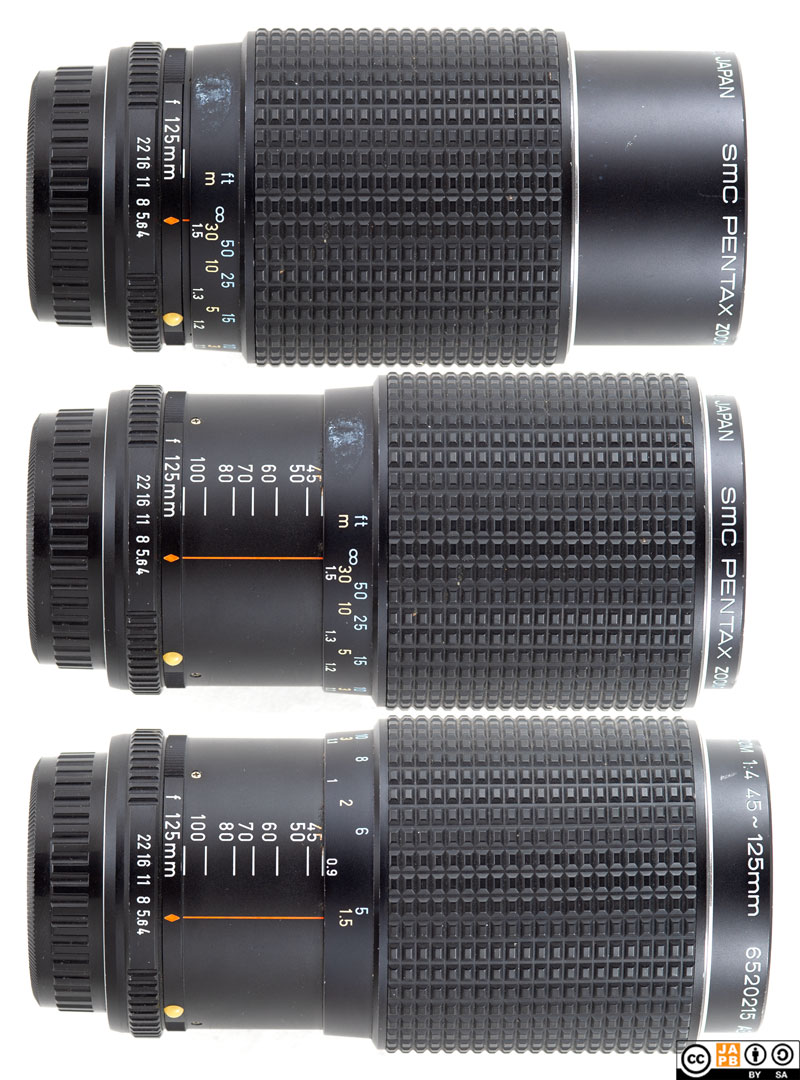
Middle: Pentax K 45–125/4 zoomed to 45 mm and focused at infinity
Bottom: Pentax K 45–125/4 zoomed to 45 mm and focused to MFD
• The lens does not change length while zooming, but it does lengthen slightly when focusing closer. The filter ring rotates while focusing.
Versions
There are four versions of this lens. All versions share exactly the same optics, and the differences relate partially to naming, but partially also whether they support an added feature.
That feature is that Pentax in 1976 started offering an optional close-up lens to be used with this lens that would complement the normal infinity to 1,5 m MFD – range with a 1,5 m to 0,9 m. To aid in using this close-up lens, Pentax made a version of the 45–125/4 lens that offered a secondary distance scale for use with that close-up lens.
| years | lens name | has distance scale for use with close-up lens? |
| 1975 | Super-Multi-Coated TAKUMAR-ZOOM 1:4/45~125 | No |
| 1975–76 | SMC PENTAX ZOOM 1:4/45~125 | No |
| 1976–77 | SMC PENTAX ZOOM 1:4/45~125 | Yes |
| 1977–84 | smc PENTAX ZOOM 1:4 45~125 | Yes |
The pictured lens is of the fourth variant.
One interesting quirk of that close-up lens is that it also acts as a 58–67 mm step-up ring. This lens therefore also was intended to be used with different lens hoods:
• lenses manufactured before the 1976 introduction of the close-up lens were to be used with a one-part lens hood for 58 mm threads
• lenses manufactured after the 1976 introduction of the close-up lens came with a two-part lens hood where one could be exchanged for the close-up lens (the rear part of the lens hood effectively was a 58–67 mm step-up ring)..
History of Asahi / Pentax
The camera business today known Pentax was founded in 1919 as Asahi Kogaku Kogyo (Asahi Optical Company). Initially the company manufactured lenses for eyeglasses, later diversifying into projection lenses and even later into photographic lenses, supplying lenses for camera makers such as Konishiroku (Konica) and Molta (Minolta) and binoculars.
In 1952 – the year of the Helsinki olympiad – Asahi released the Asahiflex, the first Japanese 35 mm SLR. Together with its SLR cameras, Asahi introduced a line of lenses that carried the name ‘Takumar’, in honour of the founder’s brother.
In 1975 Asahi/Pentax introduced its own bayonet mount – The Pentax K mount – and phased out the production of m42 lenses and cameras. The name Takumar would remain on Pentax lenses until 1979 (and made some sporadic reappearances). The Pentax K mount is still a current mount, but it has several versions/generations. For details, see the JAPB article on the Pentax K mount.
Pentax was among the handful of Japanese camera manufacturers to keep up with the introduction of autofocus SLR cameras, and even survived the shift from film SLRs to digital SLRs (albeit somewhat struggling).
Adapting
If you want to natively mount this lens you need to find a functioning Pentax K mount SLR (or a dSLR) camera. Luckily that should be relatively easy as Pentax K film bodies were produced in their millions and most of them – especially those manufactured by Pentax – have a good reliability record. Alternatively, you can use this lens on most high-end Pentax dSLRs, but only in stop-down metering mode.
Adapting this lens to a mirrorless, full-frame digital camera is a breeze thanks to the lens having full manual controls (aperture ring, focus ring). You simply need a dumb adapter from Pentax K to your mirrorless system.
Due to the medium flange focal distance used by the m42 mount (45,46 mm), whether you can adapt this lens to other than Pentax’ dSLR mounts depends on which dSLR mount: Canon EF, and Four Thirds can mount Pentax K lenses using a simple adapter ring. Minolta/Sony A and Nikon F on the other hand are not as problem-free, and – to retain anything near infinity focus – the adapter will necessitate corrective optics. In all cases, your camera will work only in stop-down metering.
Footnotes
- Focal length is (unless stated otherwise) given in absolute terms, and not in Full-frame equivalent. For an understanding of whether the lens is wide/tele, see ‘Angle-of-view’. ↩︎
- Picture angle is given in degrees (based on manufacturers’ specs) and concerns the diagonal picture angle. Rule of thumb:
> 90 ° ==> Ultra-wide-angle
70–90 ° ==> Wide-angle
50–70 ° ==> Moderate wide-angle
40–50 ° ==> ‘Standard’ or ‘normal’ lens
20–40 ° ==> Short tele lens
10-20 ° ==> Tele lens
5-10 ° ==> Long tele lens
< 5 ° ==> Ultra-tele lens ↩︎ - Length is given from the mount flange to the front of lens at infinity. ↩︎
- Diameter excludes protrusions such as rabbit ears or stop-down levers. ↩︎
- S=straight; R=rounded; C=(almost)circular at all apertures. ↩︎
- Numbers equal aperture values on aperture ring; • intermediate click; – no intermediate click. ↩︎