Pekka Buttler, 01/2026
This lens was kindly provided for cataloguing by Vladimir at #photogears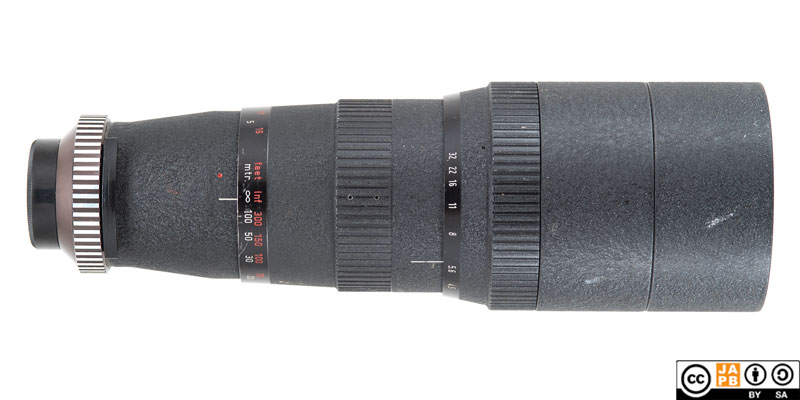
Specifications
The table below summarizes the lens’ key specifications (measurements based on pictured version of the lens):
| Brand: | ENNA München (Enna Werk München) | Lens name | Tele-Ennalyt 1:4.5/400 mm |
| Focal length(s)1 | 400 mm | Angle-of-view2 | 11 ° (on medium format) 6,2 ° (on full frame) |
| Maximum Aperture | f/4.5 | In Production | 1958– |
| Lens mount (this lens) | M42 | Other lens mounts | Exakta, Pentacon Six |
| Length3 | 262,4 mm | Diameter4 | 97,7 mm |
| Filter ring diameter | 95 mm | Weight | 2196 grams |
| Lens element count | 5 | Lens group count | 3 |
| Aperture blades (S/R/C)5 | 14 S | Focus throw | 375 ° |
| Minimum focusing distance (indicated) | ≈ 4,5 m | Maximum magnification (calculated) | 1:9 |
| Has manual aperture ring | YES | Has Manual focus ring | YES |
| Aperture mechanism type | manual | Aperture click stops | none |
Further notes:
• Detailed information on this lens is sparse. If you have hard information (such as an Enna Brochure from the 1950s), you’re welcome to be in touch.
• This lens was originally introduced in 1958 and it remained in the Enna product at least into the mid 1960s (Latest serial numbers are > 4 000 000).
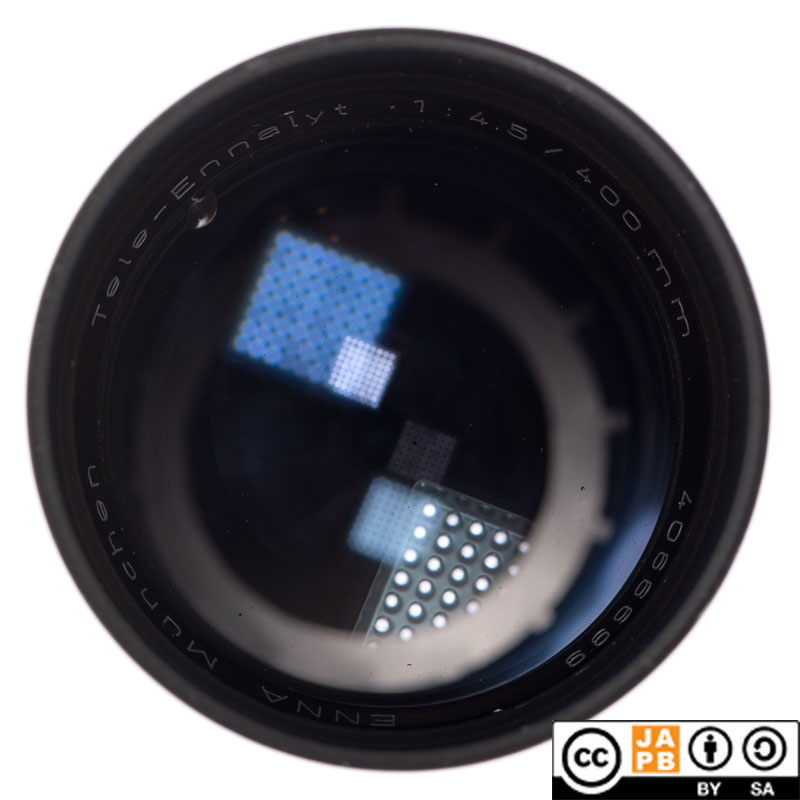
• It was originally designed as a professional-level medium format tele lens, and its image circle covers medium format comfortably. As it turned out, most samples were shipped with an M42 or Exakta mount.
• Like many lenses in this era, the mount was based on a a special adapter that any half-proficient mechanic could exchange (it was however not intended to be strictly user-replaceable).
• The use of mount adapters did open the door for easily manufacturing adapters even for other mounts. Hence one at times encounters the 400 mm Enna with mount adapters not originally envisaged.
• The lens features a rear slot for drop-in filters.
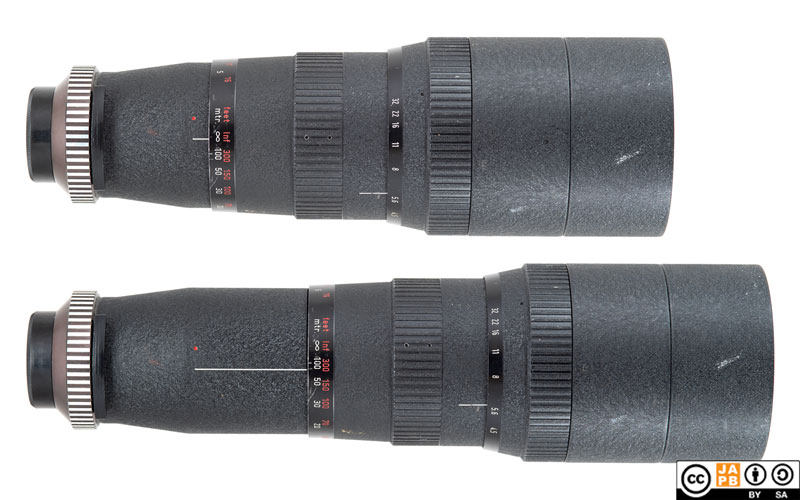
Bottom: ENNA München Tele-Ennalyt 400/4.5 focused at infinity
• While the nearest value on the focusing scale is 5 metres, at least the pictured sample allows rotating the lens’ focus ring by 375, leading to a MFD closer to 4,5 metres. Sadly the actual MFD could not be tested.
• While rarely mentioned, the 400/4.5 Tele-Ennalyt actually has a bigger brother in the 600/5.6 Tele-Ennalyt (very similar design).
Versions and variations
The Tele-Ennalyt 400/4.5 exists in at least three cosmetic variations:
Early: Glossy-black barrel, focus and aperture rings in zebra style (polished metal alternating with ribbed grip-sections).
Middle: Crinkle-matte black barrel, focus and aperture rings in with alternating ribbed grip-sections and crinkle-matte sections.
Late: Crinkle-matte black barrel, focus and aperture rings with narrow alternating striping (both crinkled) (pictured lens)
Adapting the ENNA München Tele-Ennalyt 400 mm f/4.5
Obviously, a crucial question is which mount your copy of the Tele-Ennalyt has. Once you have determined that, see below:
Adapting Exakta mount lenses
Exakta mount lenses cannot be used natively on any current SLR or dSLRs. To use it in its native environment, you will need an Exakta-mount film body. Exakta bodies were manufactured in large numbers, but many of them are no longer in a good shape. That said, procuring a workable sample should not be impossible or especially expensive.
Thanks to being a fully manual lens (manual aperture, manual focus), the lens can be adapted to all mirrorless cameras using a suitable adapter. Moreover, the Exakta lenses are so uncomplicated that a simple ‘dumb adapter’ will do the job perfectly. Furthermore, due to the popularity of the Exakta mount, special adapters (helicoid adapters, tilt/shift adapters) are readily available. Alternatively, one can choose to daisy-chain adapters (e.g. Exakta->Canon EF; Canon EF –> mirrorless) which also opens up a wide range of speed boosters .
Using Exakta lenses on dSLRs can also be an easy option, depending on which dSLR.
• Canon EF has the shortest flange focal distance among full-frame dSLR’s and Canon’s wide range of dSLRs are able to mount Exakta lenses perfectly using a simple adapter ring.
• Nikon F, Pentax K and Minolta / Sony A dSLRs need an adapter that uses corrective optics for Exakta lenses (the difference in flange focal distances is not enough to enable reaching infinity focus without corrective optics).
Adapting M42 mount lenses
If you want to natively mount an M42 lens you need to find a functioning M42 mount film camera. Luckily that should be relatively easy as M42 bodies were produced in their millions and most of them lack features that are especially likely to have deteriorated to the point of making the entire camera inoperable. If your sample of the ENNA München Tele-Ennalyt offers a switch to choose between auto- and manual aperture, I recommend using the lens on a body that is capable of stopping down the lens automatically and offers stop-down metering.
Adapting this lens to a mirrorless, full-frame digital camera is a breeze thanks to the lens having full manual controls (aperture ring, focus ring). You simply need a dumb adapter from M42 to your mirrorless system.
Due to the medium flange focal distance used by the M42 mount (45,46 mm), whether you can adapt this lens to dSLR/SLR mounts depends on which dSLR mount: Canon EF, Four Thirds, Minolta/Sony A and Pentax K can mount m42 lenses using a simple adapter ring. Nikon F on the other hand is not as problem-free, and – to retain anything near infinity focus – the adapter will necessitate corrective optics. In all cases, your camera will work only in stop-down metering.
Adapting Pentacon Six mount lenses
To use this lens natively, you will need a Pentacon 6 mount film body. In practical terms this means either a Praktisix or Pentacon Six medium format film camera or a Kiev 60/6C medium format film camera. While neither of these families of bodies were manufactured in their millions, they remain readily available, and even serviceable.
Thanks to the generous image circle Pentacon 6 lenses offer, and thanks to the copious flange focal distance (74,1 mm) of the Pentacon 6 system, this lens can be adapted to every full frame (and smaller) SLR, dSLR and mirrorless camera assuming a suitable adapter can be found or manufactured. Moreover, Pentacon 6 lenses are so uncomplicated that a simple ‘dumb adapter’ will do the job perfectly.
Thanks to the generous image circle, Pentacon 6 lenses have also long been a strong candidate to be used on smaller formats (full frame and smaller) in conjunction with tilt/shift adapters. Alternatively, one can choose to daisy-chain adapters (e.g. Pentacon 6->Canon EF; Canon EF –> mirrorless) which not only broadens the range of available adapters, but also allows using speed boosters for those photographers that use smaller than full-frame sensors.
Finally, regarding larger than full frame, there are also options. Digital medium format is perfectly usable (assuming adapter availability) and many 6×4,5 film formats are likewise theoretical possibilities, but gaining functional adapters may necessitate some DIY.
History of ENNA München
ENNA München (also: Enna Werk München) is one of the 1950s and 60s most prominent and innovative German optics companies. ENNA is especially well-known for being the West-German pioneer in developing retrofocus wide-angle lenses.
You can read more details in the ENNA München company profile.
Footnotes
- Focal length is (unless stated otherwise) given in absolute terms, and not in Full-frame equivalent. For an understanding of whether the lens is wide/tele, see ‘Angle-of-view’. ↩︎
- Picture angle is given in degrees (based on manufacturers’ specs) and concerns the diagonal picture angle. Rule of thumb:
> 90 ° ==> Ultra-wide-angle
70–90 ° ==> Wide-angle
50–70 ° ==> Moderate wide-angle
40–50 ° ==> ‘Standard’ or ‘normal’ lens
20–40 ° ==> Short tele lens
10-20 ° ==> Tele lens
5-10 ° ==> Long tele lens
< 5 ° ==> Ultra-tele lens ↩︎ - Length is given from the mount flange to the front of lens at infinity. ↩︎
- Diameter excludes protrusions such as rabbit ears or stop-down levers. ↩︎
- S=straight; R=rounded; C=(almost)circular at all apertures. ↩︎
Heyyy, i just received this lens today and it’s cool as hell. What’s kinda annoying is that rotating the aperture ring sometimes rotates the focus ring, the lens is also heavy as hell compared to all my previous lenses ‘:D. I like the lever for rotating the camera and the texture on the barrel is really pleasing. I have the middle version and the focus ring rotates by “only” 360 degrees. I love it overall, thanks for all the info in this article <3
You’re welcome.
And I totally agree with you, including the importance of being yourself (under all circumstances).
Pekka