Pekka Buttler, 12/2025
Specifications
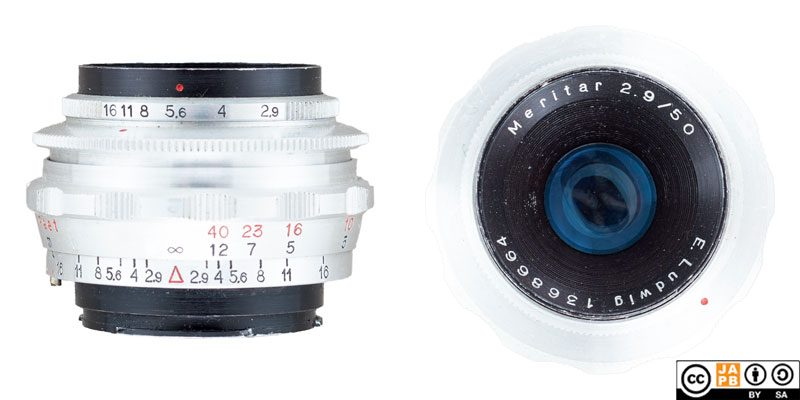
The table below summarizes the lens’ key specifications (measurements based on pictured lens):
| Brand: | E.Ludwig | Lens name | Meritar 2.9/50 4,5/40 |
| Focal length(s)1 | 50 mm | Angle-of-view2 | 47 ° |
| Maximum Aperture | f/2.9 | In Production | 1951–1968 (all variants) |
| Lens mount (this lens) | Exakta | Other lens mounts: | Altix, M42 |
| Length3 | 31,9 mm | Diameter4 | 53,0 mm |
| Filter ring diameter | 35,5 mm | Weight | 95 grams |
| Lens element count | 3 | Lens group count | 3 |
| Aperture blades (S/R/C)5 | 5 S | Focus throw | 280 ° |
| Minimum focusing distance (measured) | 86 cm | Maximum magnification (measured) | 1:16 |
| Has manual aperture ring | YES | Has Manual focus ring | YES |
| Aperture mechanism type | Preset | Aperture click stops 6 | N/A |
Further notes:
• The E.Ludwig Meritar was a post-war entry-level lens used both on budget-oriented interchangeable lens cameras as well as an integrated lens on some camera models (both 35 mm film compacts as well as medium format folding cameras)
• The Meritar design is a classic example of the ‘Cooke triplet’ recipe.
Versions
During the ≈15 years of Meritar production, the ergonomic design changed quite a bit, and coatings became gradually more elaborate, but the optical design was largely unchanged. See more below
Early: Launched ca 1951 for Altix and Exa cameras
• Short lens that is narrower at the front than at the mount.
• Manual aperture
• all-silver
Medium: Launched ca 1957 for Exakta and M42 mounts [pictured sample]
• Short lens that is broadest at the focus ring (narrower at both mount and front)
• Preset aperture
• all-silver
Late: Launched ca 1963 for Exakta and M42 mounts
• Short lens that is narrower at the front than at the mount.
• Preset aperture
• zebra style focus and aperture rings. Overall very sleek design.
History of E.Ludwig
The company was originally founded in 1924 as ‘Optisches Werk Ernst Ludwig’ in Lausa near Dresden (Germany) by – you guessed it, Ernst Ludwig. The company initially specialized in affordable triplet lenses like Enoldar, Peronar, and Victar for medium-class amateur cameras.
After World War II, Ernst Ludwig continued leading the firm, introducing the Meritar series around 1949 as entry-level alternatives to Carl Zeiss Jena or Meyer-Optik Görlitz lenses. The Meritar lenses were initially produced as fixed lenses for cameras like Altix and Beirette, before also being made into interchangeable lenses for Altix, Exakta and M42 mounts.
In 1959 the East German state acquired 16% shares, and fully nationalized the company as VEB Optisches Werk Weixdorf in 1972. It was merged into VEB Pentacon in 1980.
Adapting
n.B! The following applies this lens in either Exakta or M42 mount.
This lens cannot be used natively on any current SLR or dSLRs. To use it in its native environment, you will need an Exakta or M42-mount film body. Luckily there are a lot of those (especially in M42 mount) available.
Thanks to being a fully manual lens (manual aperture, manual focus), the lens can be adapted to all mirrorless cameras using a suitable adapter. Moreover, both Exakta and M42 lenses are so uncomplicated that a simple ‘dumb adapter’ will do the job perfectly. Also, due to the popularity of both mounts, special adapters (helicoid adapters, tilt/shift adapters) are readily available. Alternatively, one can choose to daisy-chain adapters (e.g. M42->Canon EF; Canon EF –> mirrorless) which also opens up a wide range of speed boosters .
Using m42 and Exakta lenses on dSLRs can also be an easy option, depending on which dSLR.
• Canon EF has the shortest flange focal distance among full-frame dSLR’s and Canon’s wide range of dSLRs are able to mount both M42 and Exakta lenses perfectly using a simple adapter ring.
• Minolta / Sony A dSLRs are likewise able to mount M42 lenses using a simple adapter ring, but for Exakta lenses, the difference in flange focal distances is not enough to enable reaching infinity focus without an adapter that uses corrective optics.
• Pentax K dSLRs are likewise able to use M42 lenses using a simple adapter ring, but for Exakta lenses an adapter that uses corrective optics would be needed to allow infinity focus.
• Nikon F dSLRs have a long flange focal distance, meaning that mounting either M42 or Exakta lenses needs an adapter that uses corrective optics to allow anything close to infinity focus.
Footnotes
- Focal length is (unless stated otherwise) given in absolute terms, and not in Full-frame equivalent. For an understanding of whether the lens is wide/tele, see ‘Angle-of-view’. ↩︎
- Picture angle is given in degrees (based on manufacturers’ specs) and concerns the diagonal picture angle. Rule of thumb:
> 90 ° ==> Ultra-wide-angle
70–90 ° ==> Wide-angle
50–70 ° ==> Moderate wide-angle
40–50 ° ==> ‘Standard’ or ‘normal’ lens
20–40 ° ==> Short tele lens
10-20 ° ==> Tele lens
5-10 ° ==> Long tele lens
< 5 ° ==> Ultra-tele lens ↩︎ - Length is given from the mount flange to the front of lens at infinity. ↩︎
- Diameter excludes protrusions such as rabbit ears or stop-down levers. ↩︎
- S=straight; R=rounded; C=(almost)circular at all apertures. ↩︎
- Numbers equal aperture values on aperture ring; • intermediate click; – no intermediate click. ↩︎