Pekka Buttler, 12/2025
Specifications
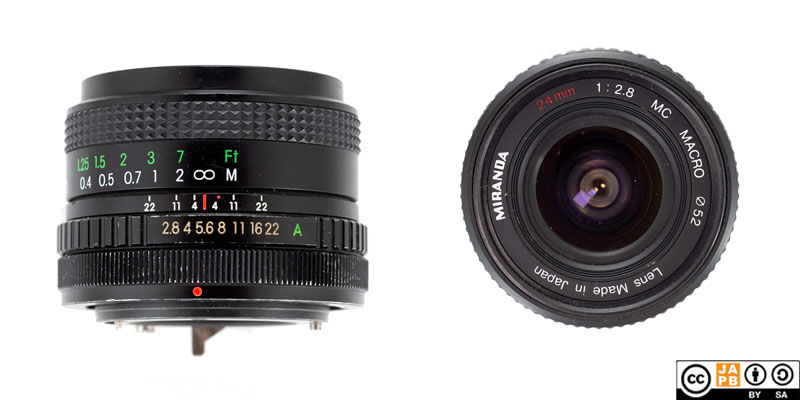
The table below summarises the lens’ key specifications (measurements based on pictured sample):
| Brand: | Miranda | Lens name | 24mm 1:2.8 MC MACRO |
| Focal length(s)1 | 24 mm | Angle-of-view2 | 84 ° |
| Maximum Aperture | f/2.8 | In Production | NB: 1976; NA 19953 |
| Lens mount (this lens) | Canon FD | Other lens mounts | Contax/Yashica, Konica AR, M42, Minolta SR, Nikon F, Olympus OM, Pentax K(KA) |
| Length4 | 46,0 mm | Diameter5 | 63,0 mm |
| Filter ring diameter | 52 mm | Weight | 186 grams |
| Lens element count | 7 | Lens group count | 7 |
| Aperture blades (S/R/C)6 | 5 S | Focus throw | 160 ° |
| Minimum focusing distance (measured) | 19,5 cms | Maximum magnification (measured) | 1:5 |
| Has manual aperture ring | YES | Has Manual focus ring | YES |
| Aperture mechanism type | Automatic | Aperture click stops 7 | 2.8-4-5.6-8-11-16-22 |
Further notes:
• Miranda was – in its heyday – an advanced Japanese camera manufacturer. Sadly it all came crashing down in the mid 1970s, after which UK camera retailer Dixons acquired the rights to the Miranda name and – in short order – started rebranding cameras and lenses under the Miranda name.
• This ‘Miranda’ lens is from that late, Dixons era. You can read more about Miranda (proper) in the JAPB company profile on Miranda camera.
• Unlike some other rebranders like Allied Impex, Porst, Revue or Vivitar, Dixons seems to have mostly sourced lenses and cameras to be sold as ‘Miranda’ from a single source: Cosina.
• This lens too is a Cosina design and was sold as the Miranda 24 mm f/2.8 MC Macro by Dixons for a wide range of mounts.
• Dixons/Miranda was by far the only brand this lens was sold under. In fact, this lens has several aliases, including:
• “Carl Zeiss Jena8 II F=24mm 1:2.8 MC MACRO”9
• “Cosina 24mm 1:2.8 MC MACRO”
• “Exakta 24mm 1:2.8 MC MACRO”
• “Miranda 24mm 1:2.8 MC MACRO”
• “Vivitar 24mm 1:2.8 MC WIDE ANGLE”
• This lens is otherwise a very ‘run-of-the-mill’ 1980s 24 mm wide-angle lens, but it does offer a MFD of 19,5 centimetres, leading to a maximum magnification of 1:5. While this does not (in my book) entirely justify the use of the phrase ‘macro’, it is a very good maximum magnification for a wide-angle lens.
Versions/variants
While Cosina did manufacture several generations of 24 mm lenses, this particular lens (with its 24 mm f/2.8 mainline specifications in combination with a 1:5 maximum magnification seems to only have been made in one variant. That variant was however sold under a wide range of names and with more than half a dozen lens mounts.
Adapting
We will here discuss adapting the pictured lens with the Canon FD lens mount. If yourcopy of the Miranda 24/2.8 Macro uses another mount,
This lens cannot be used natively on any current SLR or dSLRs. To use it in its native environment, you will need a Canon FD or FL-mount film body.
Thanks to being a fully manual lens (manual aperture, manual focus), the lens can be adapted to all mirrorless cameras using a suitable adapter. However, for the adapter to allow the lens to stop down, you will need an adapter that can be set to engage the FD lens’ aperture control lever.
Moreover, a large range of special adapters (helicoid adapters, tilt/shift adapters, speed boosters) for using Canon FD lenses on most mirrorless systems are available.
Using Canon FD lenses on dSLRs is a possibility, but is not problem free. Thanks to the relatively short flange focal distance of the Canon FD mount (at 42,0 mm, clearly shorter than that of any full-frame dSLR mount), any adapter will necessitate some corrective optics to achieve infinity focus.
Footnotes
- Focal length is (unless stated otherwise) given in absolute terms, and not in Full-frame equivalent. For an understanding of whether the lens is wide/tele, see ‘Angle-of-view’. ↩︎
- Picture angle is given in degrees and concerns the diagonal picture angle. Rule of thumb:
> 90 ° ==> Ultra-wide-angle
70–90 ° ==> Wide-angle
50–70 ° ==> Moderate wide-angle
40–50 ° ==> ‘Standard’ or ‘normal’ lens
20–40 ° ==> Short tele lens
10-20 ° ==> Tele lens
5-10 ° ==> Long tele lens
< 5 ° ==> Ultra-tele lens ↩︎ - NB means “Not Before” while NA means “Not After”. JAPB uses these when it is not not possible to pin down an exact date. In this case the NB 1976 is based on that Dixons did not start selling cameras and lenses as ‘Miranda’ prior to 1976 and the sale of this type of budget, manual focus lenses had stopped by the mid 90s. ↩︎
- Length is given from the mount flange to the front of lens at its shortest. ↩︎
- Diameter excludes protrusions such as rabbit ears or stop-down levers. ↩︎
- S=straight; R=rounded; C=(almost)circular at all apertures. ↩︎
- Numbers equal aperture values on aperture ring; • intermediate click; – no intermediate click. ↩︎
- Samples of this lens proclaim “Lens made in Japan under license from VEB Carl Zeiss Jena” ↩︎
- Importantly, there is also another Japanese-made 24 mm f/2.8 that proclaims to be a Carl Zeiss Jena lens, but that lens’ name ring says: “Carl Zeiss Jena f=24mm 1:2.8 MC MACRO Jenazoom Super” This other “Carl Zeiss Jena” 24/2.8 is a variant of the Sigma Super-Wide II 1:2.8 f=24mm. ↩︎