Pekka Buttler, 02/2026
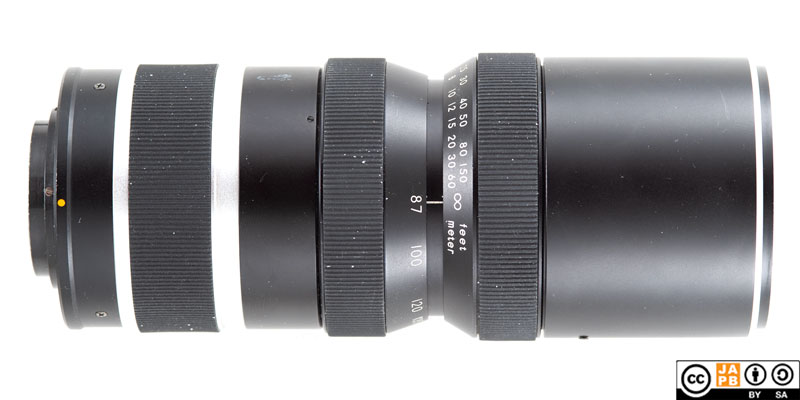
Specifications
The table below summarizes the lens’ key specifications (measurements based on pictured sample):
| Brand: | Tokyo Kogaku (Topcon) | Lens name | HI ZOOM TOPCOR 1:4.7 f=87~205mm |
| Focal length(s)1 | 87–205 mm | Angle-of-view2 | 28 – 12 ° |
| Maximum Aperture | f/4.7 | In Production (all versions) (for Topcon UV) | 1967–1978 1973–1978 |
| Lens mount (this lens) | Topcon UV | Generation | Topcon HI |
| Length3 | 159,2 mm | Diameter4 | 65,4 mm |
| Filter ring diameter | 58 mm | Weight | 689 grams |
| Lens element count | 13 | Lens group count | 8 |
| Aperture blades (S/R/C)5 | 5 S | Focus throw | 270 ° |
| Minimum focusing distance (measured) | 286 cm (@87 mm) 255 cm (@205 mm) | Maximum magnification (measured) | 1:25,3 (@87 mm) 1:10,6 (@205 mm) |
| Has manual aperture ring | NO | Has Manual focus ring | YES |
| Aperture mechanism type | N/A | Aperture click stops | N/A |
Further notes:
• The Topcon RE.Zoom Auto Topcor 87-205/4.7 was originally introduced in 1967 for Topcon’s Topcon RE -line of professionally oriented cameras. At that time (the late 1960s) Zoom lenses were conceptually incompatible6 with a budget/consumer -oriented lineup (such as Topcon’s UV line was).
• In 19737 the venerable Topcon Tele Zoom was also made available for the Topcon UV mount.
• Importantly, while this lens was introduced together with the focal plane shutter IC-1, the lens can be mounted and works without issues on every Topcon UV mount body.
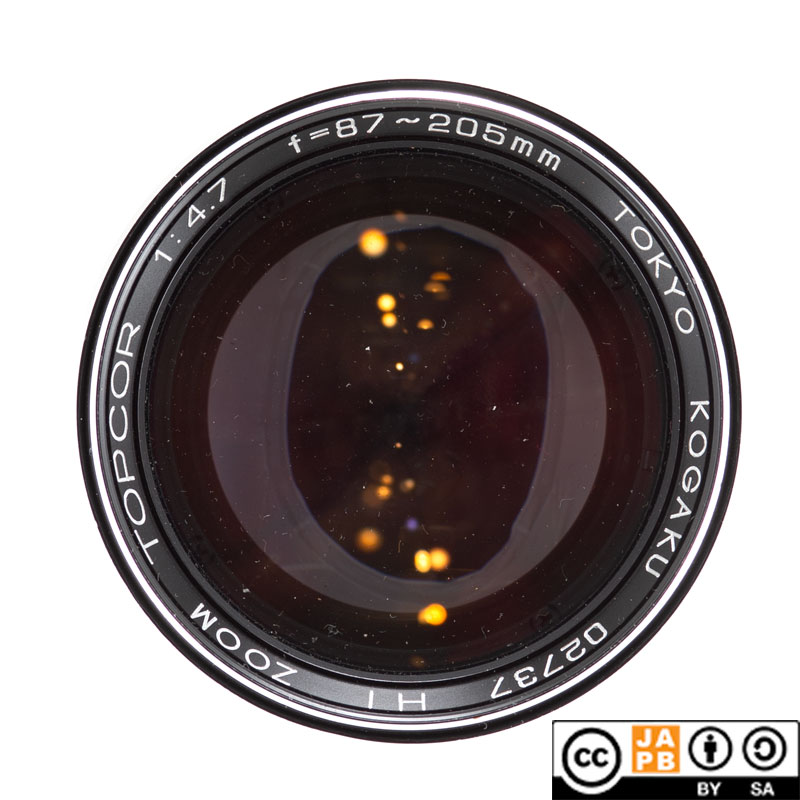
• In terms of build quality, the quality of the Topcon HI 87-205 leaves nothing to be desired. The lens has a trust-inspiring solidity and it is clear that the mechanical workmanship is second to none.
• The Topcon 87–205 lens is a two-ring zoom with one ring controlling focal length and another controlling focusing distance.
• The lens uses an internal zooming system, so the lens does not change shape as you turn the zoom ring.
• Rotating the focus ring however leads to a minor (11 mm) elongation of the lens. What’s worse, turning the focus ring rotates the entire front third of the lens (including the filter threads).
• The lens offers a rather decently sized integrated, pull out lens hood.
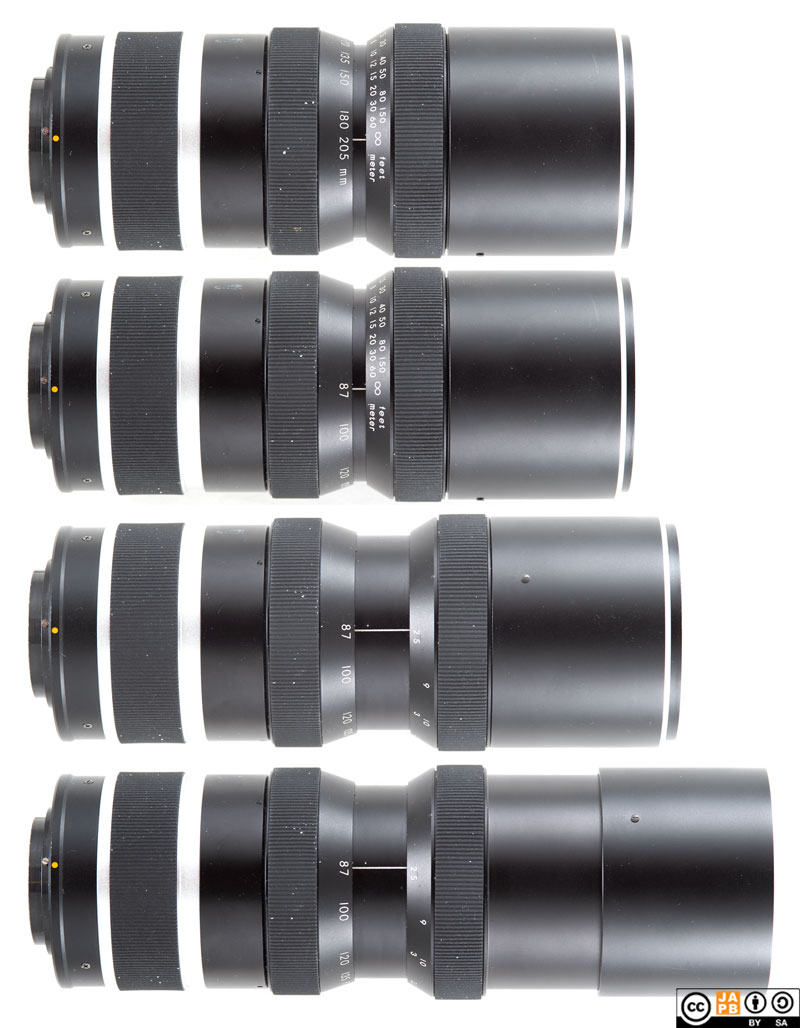
Second: Top: Topcon HI TOPCOR 87–205 mm f/4.7 zoomed to 87 and focused to infinity
Third: Top: Topcon HI TOPCOR 87–205 mm f/4.7 zoomed to 87 and focused to MFD
Bottom: Top: Topcon HI TOPCOR 87–205 mm f/4.7 zoomed to 87 and focused to MFD with hood pulled out
About Topcon HI lenses
• In 1973 Topcon introduced the IC-1 Auto (which was replaced in 1976 by the New IC-1 Auto). The IC-1 Auto was the first camera for the Topcon UV system that did not rely on a leaf shutter8 and therefore enabled lenses that were not constricted by the narrow throat diameter (22,7 mm) that the leaf shutter demanded.
• At the same time Topcon started introducing a new sub-series of lenses designed for the IC-1 Auto, and these lenses were named Topcon HI (HI Topcor) in contrast to Topcon UV.
• The following Topcon HI lenses were introduced before discontinuation of the system:
• Topcon HI 87-205mm f/4.7 (introduced 1973/74) (this lens)
• Topcon HI 50 mm f/2 [data sheet] (introduced 1973/74)
• Topcon HI 50 mm f/2.8 [data sheet] (introduced 1976)
• Topcon HI 55 mm f/1.8 [data sheet] (introduced 1976)
• Topcon HI lenses are a subclass of the Topcon UV lenses in that their physical mount and lens-body communication are identical, but in terms of compatibility there is a quirk: While Topcon UV lenses can (without restrictions) be used on all Topcon UV bodies (from the 1963 Wink Mirror S to the 1976 New IC-1 Auto), some Topcon HI lenses were compatible only with the 1973 IC-1 Auto and the 1976 New IC-1 Auto). To date the only Topcon HI lens that seems to be incompatible with the pre 1973 camera models is the Topcon HI 55 mm f/1.8. The key difference can be illustrated with the picture below:
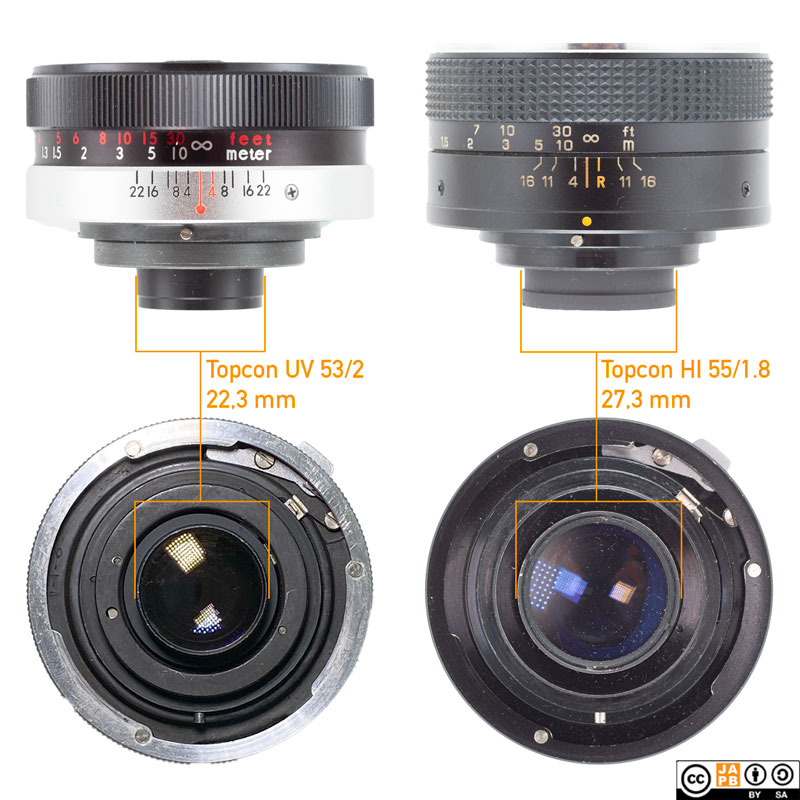
• The three other Topcon HI lenses: The Topcon HI 50 mm f/2, the Topcon HI 50 mm f/2.8 (which replaced the Topcon UV 50/2 and Topcon UV 50/2.8 respectively) and the Topcon HI 87–205/4.7 actually do fit within the throat/leaf shutter mechanism of all the Topcon UV cameras I have tested9.
• While it is not explicitly mentioned anywhere, JAPB’s conjecture is that Topcon had in the early 70s embarked on a general redesigning of their lineup of lenses for the UV system and had decided to call their new generation of lenses HI (and that this redesigning was simply cut short by Topcon’s 1978 decision to withdraw from making cameras).
Versions and variations
As noted, the Topcon 87-205/4.7 Zoom is available both for the Topcon RE and Topcon UV mounts. If you can choose freely, I recommend a Topcon RE-mount version as those lenses have an aperture ring.
The original Topcon RE version of the 87-205 zoom was manufactured both in Topcon’s signature matte silver colour scheme as well as in the later all-black scheme.
The later Topcon UV version of the 87-205 zoom was only available in a mostly-black colour pattern that featured two silver-coloured highlight rings towards the camera end (see picture above).
History of Topcon
Unless you know your camera lore, you might not know that Topcon was once – between 1957 and 1976 – one of the foremost camera companies in the world.
You can read more details in the Topcon company profile.
Adapting
Adapting Topcon UV lenses is not especially easy, but this is not so much due to the lens mount. Technically the Topcon UV mount is very much like the DKL mount, and adapters for the DKL mount have existed for ages. Moreover, the Topcon UV mount offers a generous flange focal distance, making it relatively easy to manufacture adapters, even to SLR mounts.
The real reason why adapting Topcon UV lenses is relatively difficult is the simple weak availability of suitable adapters. It seems practically no-one bothered manufacturing adapters to allow the use of Topcon UV lenses on SLRs, and even with today’s most popular mirrorless mounts, you have to dig deep into aliexpress to find a metal adapter from Topcon UV to Sony FE/NEX (eBay has some 3D printed adapters). There are also some enterprising mechanics who have repurposed broken Topcon UV cameras to manufacture adapter rings.
(Remember that because Topcon UV lenses lack an aperture ring, that is a functionality that the adapter must supply.)
With these limitations in mind, below are (in the current state of affairs) the situation for adapting Topcon UV lenses.
This lens cannot be used natively on any current SLR or dSLRs. To use it in its native environment, you will need a Topcon UV series film body. While these were never produced in immense numbers, they seem to have stood the test of time reasonably well, and can still be found in a functioning condition.
While Topcon UV lenses are manual focus lenses, they lack an aperture ring. Hence, to adapt a Topcon UV lens to a mirrorless camera, you need an adapter that not only offers the correct mounting system and flange focal distance, but also allows you to control the Topcon UV lens’ aperture mechanism. As noted above, such adapters are available, but their availability is surprisingly weak. No special adapters (helicoid adapters, tilt/shift adapters) are currently available.
Using Topcon UV mount lenses on an SLR/dSLRs could be an option (there are no physical reasons why the mount could not be adapted), and Topcon themselves used to offer an adapter allowing the mounting of Topcon UV lenses on Topcon RE cameras. However, it seems that there are currently only cottage industry adapters available. Moreover, as the rearmost element of many Topcon UV lenses protrudes significantly beyond the flange, it is not inconceivable that some Topcon UV lenses would (assuming there was an adapter) risk colliding with the mirrors on some dSLRs.
Footnotes
- Focal length is (unless stated otherwise) given in absolute terms, and not in Full-frame equivalent. For an understanding of whether the lens is wide/tele, see ‘Angle-of-view’. ↩︎
- Picture angle is given in degrees (based on manufacturers’ specs) and concerns the diagonal picture angle. Rule of thumb:
> 90 ° ==> Ultra-wide-angle
70–90 ° ==> Wide-angle
50–70 ° ==> Moderate wide-angle
40–50 ° ==> ‘Standard’ or ‘normal’ lens
20–40 ° ==> Short tele lens
10-20 ° ==> Tele lens
5-10 ° ==> Long tele lens
< 5 ° ==> Ultra-tele lens ↩︎ - Length is given from the mount flange to the front of lens at infinity. ↩︎
- Diameter excludes protrusions such as rabbit ears or stop-down levers. ↩︎
- S=straight; R=rounded; C=(almost)circular at all apertures. ↩︎
- According to a 1970 US dealer price list the recommended net price of a Topcon UV body with standard lens was between 162 $ (Topcon Uni/100) and 200 $ (Topcon Unirex). At the same time the RE.Zoom Auto Topcor 87-205/4.7 had a recommended net price of 350$. ↩︎
- Note: Some sources have indicated the lens would have been launched for the Topcon UV mount as early as 1972, but this is doubtful because of two indicators: Firstly, I have tried, but have not found a single “Topcon UV 87-205” zoom. Instead they have all gone by the “Topcon HI” moniker that was introduced only together Topcon IC-1 Auto focal plane shutter camera in 1974. Second, none of the available documentation on the Topcon Unirex EE (1972–1974) camera indicates that a zoom lens would have been available or in the works. If someone has evidence to the contrary, I would love you to prove me wrong. ↩︎
- Topcon’s parter Seikosha had decided to end production of the leaf shutters earlier Topcon UV cameras (Wink Mirror S, Uni, Unirex, Unirex EE) had depended on. ↩︎
- Which are all but the Wink Mirror S. ↩︎