
Pekka Buttler (July 2026)
Introduction
Tamron is many things, but (considering the topic of this article) Tamron is also the quintessential lens manufacturer – a company that has offered its lenses under its own brand for a wide range of camera systems over several decades (also supplying re-branders and house labels with optics), without having also dabbled in camera manufacture1
Tamron (like most lens manufacturers) has systematically weighted its offering towards those areas where camera manufacturers’ own lenses have not been competitive (while staying clear of those areas where the camera manufacturers’ own lenses have easily dominated). Hence one can (in most eras) clearly see that while Tamron has not offered basic standard lenses, its lineup has strongly featured those lenses where camera manufacturers’ own offerings would have been prohibitively priced for the amateur. This list includes wide-angle lenses, long tele lenses as well as (increasingly from the early 70s) zoom lenses.
This article tries to embrace the lineup of Tamron lenses with two exclusions:
• First, this article only lists those Tamron-made lenses sold under the Tamron brand.
• Second, this article focuses on pre-autofocus ‘Tamron’ lenses (as JAPB’s focus is on legacy lenses). In practice this means that our focus is on those Tamron lenses that used one or another intermediate lens mount.
Please note that this article does not claim to be complete and will be updated as new data is unearthed.
If you feel that you want to learn more about the company, feel free to start with the JAPB Company profile for Tamron.
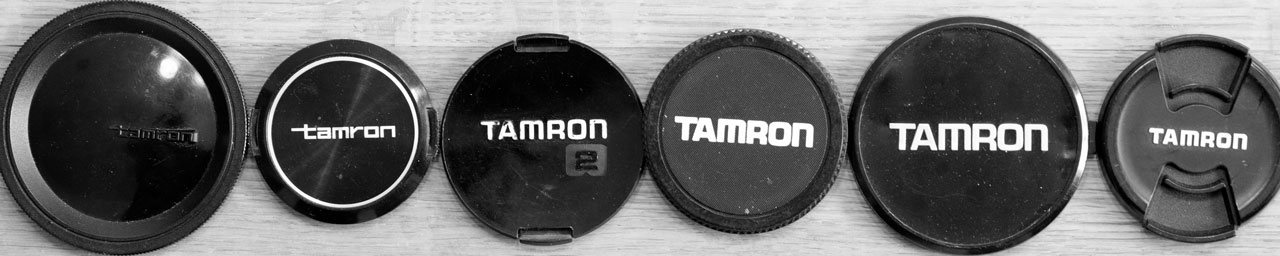
Tamron lens technology
Being a company that offered its optics for several competing camera systems, the mounting technology has been a key element to Tamron’s competitiveness. Importantly, Tamron has been an early pioneer of using intermediate mounts and much of Tamron’s progress can be understood by looking at the progress from one intermediate mount to the next. At the same time, we will also look at Tamron’s fixed mount lenses separately.
‘mini-T’ mount
Starting in 1957, Tamron used an intermediate thread mount (M37x0,75 mm thread) that has later been named the ‘mini’ T mount. These lenses are very rare and clear data is scarce.
T/T-2 (1960s) lenses
First, feel free to take a look at the JAPB article on the T/T-2 intermediate lens mount. Data on these early lenses is somewhat sketchy and the listing is very likely incomplete.
The T-mount is a fully manual, dumb mount that does not facilitate any camera->lens communication. Hence all T/T-2 mount lenses are either manual aperture or preset aperture lenses. Tamron discontinued the T/T-2 lenses in favour of the subsequent Adapt-a-matic mount in 1969–1970 so unless other production end dates are given, production ended ca 1969–70.
During this era Tamron also launched variants of some of these lenses with fixed mounts. Those are available in the table of fixed-mount lenses (at the end of this article).
| Focal length | Max. ap. | Model # | Years | Construction | MFD | Filter | Weight | Size (l/d) | Notes |
|---|---|---|---|---|---|---|---|---|---|
| 35 mm | f/2.8 | 460 | 1961– | 6e / 5g | 0,9m | 46mm | 190g | unknown | |
| 58 mm | f/1.2 | 380 | 1960- | 8e / 6g | 0,54m | 58mm | 449g | unknown | 2 |
| 135 mm | f/2.8 | 680 | 1962– | 4e / 4g | 1,44m | 58mm | 430g | 81/65 mm | [data sheet] |
| 135 mm | f/3.5 | 860 | 1963– | 4e / 4g | 2m | 49mm | 270g | unknown | |
| 135 mm | f/4.5 | 280 | 1958–62 | 4e / 2g | 2m | unknown | 205g | unknown | 3 |
| 180 mm | f/3.5 | JH-35 | 1963– | 4e /4g | 2,5m | 62mm | 645g | 139/? mm | |
| 200 mm | f/2.8 | 360 | 1960– | 5e / 3g | 3m | unknown | 1545g | unknown | |
| 200 mm | f/3.5 | 870 | 1963- | 4e / 4g | 3m | 67mm | 715g | unknown | |
| 200 mm | f/5.9 | FO-59 | 1963– | 3e / 2g | 2,5m | 49mm | 280g | 160/54 mm | |
| 200 mm | f/6.3 | FO-63 | 1963– | 3e / 2g | 2,5m | 49mm | 250g | 170/54 mm | |
| 250 mm | f/4.5 | FG-45 | 1963– | 4e/ 2g | 2,5m | 62mm | 550g | 177/? mm | |
| 300 mm | f/5.6 | 670 | 1962– | 4e / 2g | 3,5m | 62mm | 488g | 202/? mm | |
| 300 mm | f/6.9 | SO-69 | 1963– | 3e / 2g | 6m | 58mm | 560g | 267/? mm | |
| 350 mm | f/5.6 | 750 | 1963– | 4e / 2g | 5m | 67mm | 684g | 251/? mm | |
| 400 mm | f/5.6 | 340 | 1960– | 5e / 4g | 8m | unknown | 1320g | 278/? mm | |
| 400 mm | f/6.9 | FO-69 | 1963- | 4e / 2g | 9m | 62mm | 690g | 306/? mm | 4 |
| 400 mm | f/7.5 | 490 | 1961– | 4e / 2g | 9m | 58mm | 546g | 313/? mm | |
| 400 mm | f/8 | YO-8 | 1965– | 3e / 2g | 10m | 58mm | 620g | unknown | |
| 450 mm | f/8 | 880 | 1963– | 4e / 2g | 8m | 67mm | 762g | 338/? mm | |
| 55–90 mm | f/4 | PZ-50 | 1964– | 7e / 5g | 1,5m | 67mm | 580g | 104/71 mm | |
| 95–205 mm | f/5.6 | PZ-60P | 1965- | 9e / 7g | 2m | 58 mm | 550g | 176/60 mm | |
| 95–205 mm | f/6.3 | 910P | 1961-65 | 7e / 6g | unkn. | unknown | unknown | unknown | |
| 95-250 mm | f/5.6 | PZ-10II | 1965– | 9e / 7g | 2,5m | 62mm | 765g | 200/65 mm | |
| 200-400 mm | f/6.3 | PZ-70 | 1965- | 8e / 6g | 3,7m | 77mm | 1275g | 334/83 mm |
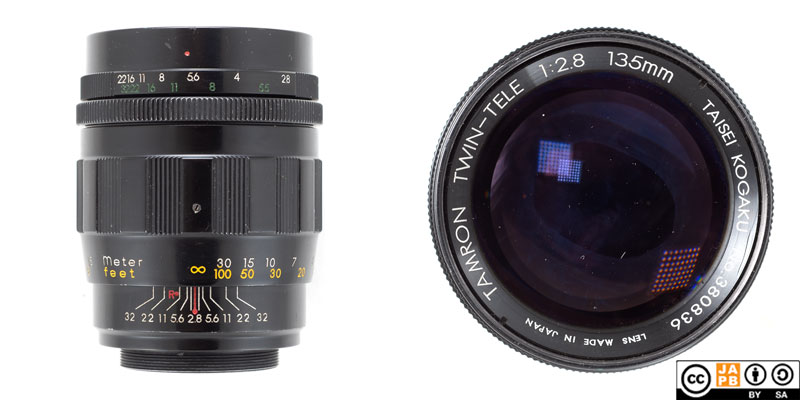
Adapt-a-matic (1969–73) lenses
Tamron started introducing lenses using the Adapt-a-matic intermediate mount in 1969. The transition to the adapt-a-matic mount was necessitated by the increasing popularity of auto aperture (automatic stopping down of lenses for taking the shot) and the key task of the adapt-a-matic adapter ring was to:
• allowing adjusting for different (physical) mounts and flange focal distances, and
• convert the various implementations of automatic aperture (see ) into the one used by the adapt-a-matic intermediate mount.
(You’re welcome to read more details in the JAPB article on the adapt-a-matic intermediate mount.)
Some collectors consider the adapt-a-matic generation of lenses especially attractive because of the combination of a high level of workmanship with a lens lineup that was skewed towards primes while originating in an era predating the widespread use of computers in lens design.
The adapt-a-matic intermediate mount clearly was a step in the right direction but it turned out to be an insufficient step, as high-end camera manufacturers increased automation and exposure modes, meaning that camera->lens communication alone was insufficient. Instead also lenses needed to be able to communicate things (such as the selected aperture and minimum aperture to the cameras). Therefore Tamron discontinued the adapt-a-matic lens lineup in 1973 in favour of the adaptall line of lenses.
| Focal length | Max. ap. | Model # | Years | Construction | MFD | Filter | Weight | Size (l/d) | Notes |
|---|---|---|---|---|---|---|---|---|---|
| 21 mm | f/4.5 | PFJ-45Au | 1970-73 | 8e / 6g | 0,25m | 82mm | 332g | 55/84 mm | 5,6 |
| 24 mm | f/3.5 | PFY-35Au | 1971–73 | 8e / 6g | 0,25m | 72mm | 320g | 75/65 mm | |
| 28 mm | f/2.8 | PFH-28Au | 1969–71? | 7e / 7g | 0,22m | 62mm | 245g | 59/67 mm | |
| 28 mm | f/2.8 | ? | 1972?–73 | 7e /7g | 0,24m | 58mm | 280g | 57/68 mm | [data sheet] |
| 35 mm | f/2.8 | PSG-35Au | 1969–73 | 6e / 5g | 0,3m | 55mm | 255g | 54/68 mm | 7 |
| 105 mm | f/2.5 | JOG-25Au | 1972–73 | 4e / 4g | 1,13m | 52mm | 482g | 87/70 mm | [data sheet] |
| 135 mm | f/2.8 | JSG-28Au | 1972-73 | 4e / 4g | 1,5m | 58mm | 415g | 89/64mm | |
| 135 mm | f/3.5 | unknown | 1973? | 4e / 4g | 1,5 | 55 mm | unknown | unknown | 8 |
| 200 mm | f/3.5 | 870Au | 1971–73 | 4e / 4g | 2,0m | 62mm | 790g | 154/70 mm | |
| 200 mm | f/4.5 | FO-45Au | 1972–73 | 4e / 3g | 2,5m | 52mm | 480g | 127/75 mm | |
| 300 mm | f/5.6 | 670Au | 1972–73 | 4e / 2g | 2,5m | 62mm | 795g | 203/70 mm | |
| 70–220 mm | f/4 | PZ-30Au | 1969–73 | 14e / 11g | 2,0m | 67mm | 1045g | 189/72 mm | [data sheet] 9 |
| 80–250 mm | f/3.8 | PZ-20Au | 1969–73 | 14e / 9g | 2,0m | 72mm | 1280g | 233/76 mm | 10 |
| 85–205 mm | f/3.5 | PZ-60Au | 1972–73 | 14e / 12g | 2,0m | 62mm | 990g | 162/72 mm | |
| 200-500 mm | f/6.9 | PZ-150Au | 1969-73 | 14e / 8g | 3,0m | 82mm | 2570g | 370/90 mm | 11 |
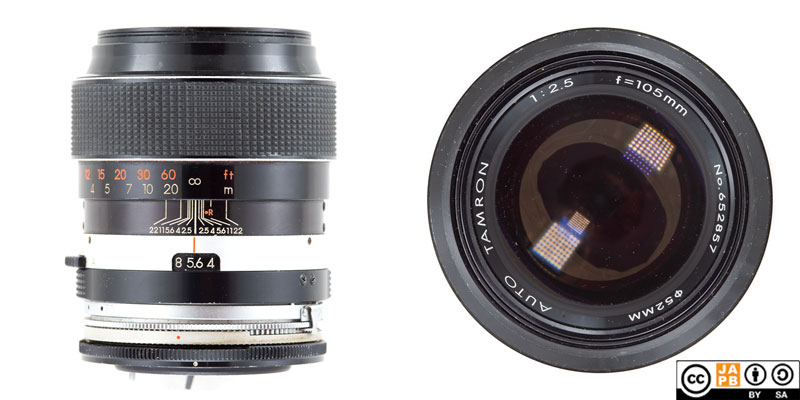
Adaptall (1973–79) lenses
As indicated above, there were clear technical reasons for the discontinuing of the Adapt-a-matic mount in favour of the Adaptall mount in 1973. However, even the Adaptall mount turned out to be insufficient. Hence, the Adaptall-2 mount was launched in 1979 to extend and replace the Adaptall(-1) mount by adding a way for the lens (and adapter) to communicate the lens’ maximum aperture (something needed for exposure automation).
While Adaptall and Adaptall-2 lenses and adapters are largely compatible (but you cannot make an Adaptall lens offer the full Adaptall-2 feature set just by using an Adaptall-2 adapter), the different series constitute two very distinct lens series. Hence we present the Adaptall(-1) series lenses separately from the Adaptall-2 series. See more in the JAPB article on the Adaptall- and Adaptall-2 mounts.
From the 1973 introduction of the Tamron Adaptall system, Tamron increasingly focused on zoom lenses. At the same time, Tamron seems to have felt that its series of intermediate mount lenses did not satisfy all customer groups as they simultaneously12 launched the Tamron-F series of fixed mount lenses. While the Tamron-F lenses correspond (in terms of cosmetics and optics) with Adaptall lenses, these will be covered in the table of fixed-mount lenses (at the end of the article).
| Focal length | Max. ap. | Model # | Years | Construction | MFD | Filter | Weight | Size (l/d) | Notes |
|---|---|---|---|---|---|---|---|---|---|
| 24 mm | f/2.5 | CW-24 | 1976– | 10e / 9g | 0,25m | 55mm | 220g | 38/65 mm | |
| 28 mm | f/2.8 | CW-28 | 1976- | 7e / 7g | 0,25m | 52mm | 240g | 42/65 mm | 13 |
| 105 mm | f/2.5 | CT-105 | 1976– | 4e / 4g | 1,27m | 52mm | 260g | 52/65 mm | [data sheet] |
| 135 mm | f/2.8 | CT-135 | 1976– | 4e / 4g | 1,5m | 55mm | 375g | 77/65 mm | 14 |
| 200 mm | f/3.5 | CT-200 | 1976– | 4e / 3g | 2,5m | 62mm | 520g | 115/69 mm | 15 |
| 300 mm | f/5.6 | CT-300 | 1976– | 4e / 4g | 2,5m | 58mm | 580g | 161/68 mm | [data sheet] 16 |
| 35–80 mm | f/2.8–3.5 | QZ-35M | 1978– | 13e/ 13g | 1,2m | 62mm | 520/600g | 87/65 mm | [data sheet] |
| 38–100 mm | f/3.5 | SZ-38 | 1973–76 | unknown | 1,28m | 72mm | 770/835g | 115/75 mm | [data sheet] 17 |
| 38–100 mm | f/3.5 | CZ-38M | 1976– | 13e / 10g | 1,5m | 67mm | 725g | 110/71 mm | |
| 70–150 mm | f/3.8 | CZ-715 | 1976–78 | 12e / 10g | 2,0m | 52mm | 465g | 117/65 mm | |
| 70–150 mm | f/3.5 | CZ-150 | 1976–78 | 12e / 10g | 1,41m | 52mm | 460/520g | 118/64 mm | [data sheet] |
| 70–150 mm | f/3.5 | QZ-150M | 1978- | 13e / 11g | 1,36m | 52mm | 550/605g | 127/65 mm | [data sheet] |
| 70–220 mm | f/3.8 | Z-220 | 1973–76 | 14e / 11g | 2,5m | 62mm | 1050g | 180/71 mm | 18 |
| 70–350 mm | f/4.5 | CZ-735 | 1976– | 15e / 13g | 2,5m | 82mm | 1820g | 274/90 mm | |
| 80–250 mm | f/3.8 | Z-250 | 1973–76 | unknown | 2,0m | N/A | 1280g | 207/79 mm | 19 |
| 80–250 mm | f/3.8–4.5 | CZ-825 | 1976–78 | 13e / 10g | 1,5m | 62mm | 950g | 180/71 mm | |
| 80–250 mm | f/3.8–4.5 | QZ-250M | 1978– | 13e / 10g | 1,5m | 62mm | 880g | 180/71 mm | |
| 85–210 mm | f/4.5 | Z-210 | 1973-76 | 12e / 9g | 1,85m | 55mm | 720/768g | 150/65 mm | [data sheet] 20 |
| 85–210 mm | f/4.5 | CZ-210M | 1976-78 | 12e / 9g | 2,0m | 55mm | 640g | 145/66 mm | |
| 85–210 mm | f/4.5 | QZ-210M | 1978- | 12e / 9g | 1,82m | 55mm | 612/667g | 147/65mm | [data sheet] |
| 200-500 mm | f/6.9 | Z-500 | 1974-76 | 14e / 8g | 3,0m | 82mm | 2740g | 370/90 mm | |
| 200–500 mm | f/6.9 | CZ-500 | 1976- | 14e / 8g | 3,0 | 82mm | 2796g | 370/90 mm |
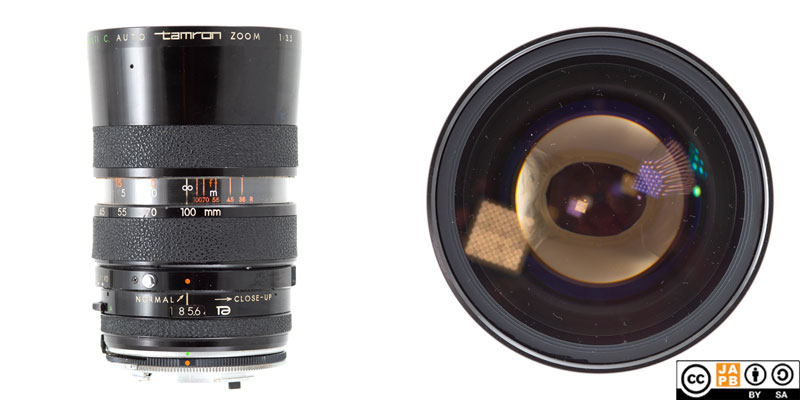
Adaptall-2 (1979–2006) lenses
In 1979 Tamron upgraded the Adaptall system to the Adaptall 2 system. This would remain Tamron’s last intermediate mount system, as the requirements placed on lens mounts by autofocus and electronic camera<->lens communication increasingly made intermediate mounts and untenable solution.
At the same time, Tamron divided its lineup of Adaptall lenses into two distinct categories: there were the (plain) Tamron lenses, aimed squarely at the budget-first consumer, as well as the SP-line (Superior Performance) of Adaptall lenses aimed at the budget-also consumer who was willing to pay a bit more for a higher quality lens (but did not want to pay the brand premium of whatever camera system they were using). The launch of the Tamron SP line was a considerable product development and marketing effort at the time, but helped cement Tamron as a lens maker a peg above the grey mass of competitors (many of which we have not heard of in years).
While the proliferation of autofocus systems and electronic communication (from 1985 onward) spelled the end for the mainstream appeal of intermediate mount lenses, some of the more special Adaptall-2 lenses were kept in production into the early 2000s. Surely a testament to their optical competitiveness.
The table below contains both Adaptall (plain) and Adaptall SP lenses. All lenses with Adaptall-2 mount.
| Focal length | Max. ap. | Model # | SP? | Years | Construction | MFD | Filter | Weight21 | Size (l/d) | Notes |
|---|---|---|---|---|---|---|---|---|---|---|
| 17 mm | f/3.5 | 51B | YES | 1979–84 | 12e / 10g | 0,25 m | None | 270 g | 48/70 mm | 22 |
| 17 mm | f/3.5 | 151B | YES | 1989–2000 | 12e / 10g | 0,25 | 82 mm | 323 g | 48/71 mm | |
| 24 mm | f/2.5 | 01B | NO | 1979–87 | 10e / 9g | 0,25 m | 55 mm | 230 g | 43/65 mm | |
| 24 mm | f/2.5 | 01BB | NO | 1987–2000 | 10e / 9g | 0,25 m | 55 mm | 227/283 g | 43/68 mm | |
| 28 mm | f/2.5 | 02B | NO | 1979–92 | 7e / 7g | 0,26 m | 49 mm | 174/- g | 38/65 mm | [data sheet] |
| 90 mm | f/2.5 | 52B | YES | 1979–83 | 8e / 6g | 0,39 m | 49 mm | 420 g | 71/65 mm | 23 |
| 90 mm | f/2.5 | 52BB24 | YES | 1983–88 | 8e / 6g | 0,39 m | 55 mm | -/472 g | 78/67 mm | [data sheet] |
| 90 mm | f/2.8 | 72B | YES | 1996–2006 | 10e / 9g | 0,29 m | 55 mm | 425 g | 102/69 mm | |
| 135 mm | f/2.5 | 03B | NO | 1979–84 | 4e / 4g | 1,2 m | 58 mm | 410 g | 84/65 mm | |
| 180 mm | f/2.5 | 63B | YES | 1988–92 | 10e / 7g | 1,2 m | 77 mm | 800/855 g | 124/82 mm | LD-IF |
| 200 mm | f/3.5 | 04B | NO | 1979–84 | 5e / 5g | 1,7 m | 58 mm | 540 g | 113/68 mm | |
| 300 mm | f/2.8 | 107B | YES | 1983–84 | 7e / 6g | 3,0 m | 112/43 mm25 | 2071 g | 204/118 mm | LD |
| 300 mm | f/2.8 | 60B | YES | 1984–92 | 10e / 7g | 2,5 m | 112/43 mm25 | 2096/ 2152g | 215/118 mm | LD-IF |
| 300 mm | f/2.8 | 360B | YES | 1992–2006 | 10e / 7g | 2,5 m | 112/43 mm25 | 2269g | 213/118 mm | LD-IF |
| 300 mm | f/5.6 | 54B | YES | 1979–84 | 6e / 5g | 1,4 m | 58 mm | 610 g | 168/65 mm | |
| 350 mm | f/5.6 | 06B | YES | 1981–85 | 7e / 4g | 1,1 m | 82/30,5 mm25 | 577 g | 79/86 mm | mirror lens |
| 400 mm | f/4 | 65B | YES | 1988–95 | 10e / 7g | 3,0 m | 112/43 mm25 | 2270/2325 g | 298/118 mm | LD-IF |
| 500 mm | f/8 | 55B | YES | 1979–83 | 7e / 4g | 1,7 m | 82/30,5 mm23 | 575 g | 92/84 mm | mirror lens |
| 500 mm | f/8 | 55BB30 | YES | 1983–2006 | 7e / 4g | 1,7 m | 82/30,5 mm23 | 595 g | 92/84 mm | mirror lens |
| 24-48 mm | f/3.5–3.8 | 13A | YES | 1980–87 | 10e / 9g | 0,6 m | 31 | 346 g | 66/65 mm | |
| 28-50 mm | f/3.5–4.5 | 07A | NO | 1980–82 | 9e / 9g | 0,25 m | 58 mm | 297 g | 51/65 mm | |
| 28–70 mm | f/3.5–4.5 | 44A | NO | 1986–88 | 8e / 8g | 0,3 m | 62 mm | 361/417 g | 75/69 mm | |
| 28–70 mm | f/3.5–4.5 | 59A | NO | 1988–91 | 9e / 8g | 0,7 m | 52 mm | 295 g | 58/65 mm | |
| 28–70 mm | f/3.5–4.5 | 159A | NO | 1991–2005 | 9e / 8g | 0,7 m | 52 mm | 194/254 g | 63/65 nm | 32 |
| 28–80 mm | f/3.5–4.2 | 27A | YES | 1983–87 | 9e / 8g | 0,36 m | 67 mm | 480 g | 87/70 mm | |
| 28–105 mm | f/2.8 | 176A | YES | 1994–2002 | 15e / 13g | 0,44 m | 82 mm | 845/905 g | 112/84 mm | 33 |
| 28–135 mm | f/4–4.5 | 28A | YES | 1983–88 | 17e / 10g | 2,0 m | 67 mm | 710/771 g | 111/70 mm | |
| 28–200 mm | f/3.8–5.6 | 71A | NO | 1994-98 | 16e / 14g | 2,1 m | 72 mm | 516 g | 79/82 mm | 34 |
| 28–200 mm | f/3.8–5.6 | 171A | NO | 1998–2006 | 16e / 14g | 0,8 m | 72 mm | 448/508g | 79/75 mm | 35 |
| 35–70 mm | f/3.5–4.5 | 09A | NO | 1980–83 | 7e / 7g | 0,25 m | 58 mm | 303/350 g | 58/65 mm | [data sheet] |
| 35–70 mm | f/3.5 | 17A | NO | 1982–87 | 7e / 7g | 0,25 m | 58 mm | 330/390 g | 67/70 mm | [data sheet] |
| 35–80 mm | f/2.8–3.8 | 01A | YES | 1979–85 | 9e / 8g | 0,27 m | 62 mm | 386 g | 77/65 mm | |
| 35–105mm | f/2.8 | 65A | YES | 1991–94 | 17e / 14g | 1,0 m | 67 mm | 624 g | 97/72 mm | 36 |
| 35–135 mm | f/3.5–4.2 | 22A | NO | 1982–85 | 14e / 12g | 1,8 m/ 0,8 m | 67 mm | 625 g | 110/73 mm | [data sheet] |
| 35–135 mm | f/3.5–4.5 | 40A | NO | 1985–96 | 15e / 13g | 0,8 m | 58 mm | 547/603 g | 101/65 mm | |
| 35–210 mm | f/3.5–4.2 | 26A | YES | 1983–87 | 16e / 12g | 1,6 m | 67 mm | 875/931 g | 126/73 mm | |
| 60–300 mm | f/3.8–5.4 | 23A | YES | 1983–2000 | 15e / 11g | 1,9 m | 62 mm | 870/926 g | 166/68 mm | |
| 70–150 mm | f/2.8 | 51A | YES | 1979–83 | 14e / 10g | 1,0 m | 62 mm | 760 g | 152/68 mm | SOFT37 |
| 70–150 mm | f/3.5 | 02A | NO | 1979–80 | 13e / 11g | 1,5 m | 52 mm | 520/585 g | 130/65 mm | |
| 70–150 mm | f/3.5 | 20A | NO | 1980–84 | 13e / 10g | 0,7 m | 49 mm | 459 g | 104/65 mm | |
| 70–150 mm | f/3.5 | 20AB38 | NO | 1982–84 | 13e / 10g | 0,7 m | 49 mm | 459 g | 104/65 mm | |
| 70–210 mm | f/3.5–4 | 52A | YES | 1979–84 | 16e / 15g | 0,75 m | 58 mm | 750 g | 170/65 mm | |
| 70–210 mm | f/3.5 | 19AH | YES | 1984–99 | 15e / 11g | 0,85 m | 62 mm | 860/916 g | 155/71 mm | |
| 70–210 mm | f/3.8–4 | 46A | NO | 1986–88 | 12e / 9g | 0,9 m | 58 mm | 550/625 g | 140/66 mm | [data sheet] |
| 70–210 mm | f/4 | 47A | NO | 1987–89 | 15e / 11g | 1,5 m | 58 mm | 855 g | 158/74 mm | AF IF 39 |
| 70–210 mm | f/4-5.6 | 58A | NO | 1988-91 | 13e / 9g | 1,1 m | 52 mm | 350 g | 79/67 mm | |
| 70–210 mm | f/4–5.6 | 158A | NO | 1991 | 13e / 9g | 1,1 m | 52 mm | 350 g | 79/67 mm | 40 |
| 70–350 mm | f/4.5 | 05A | NO | 1979–84 | 15e / 13g | 2,5 m | 82 mm | 2170 g | 279/90 mm | |
| 75–250 mm | f/3.8–4.5 | 04A | NO | 1979–82 | 13e / 11g | 1,2 m | 62 mm | 870 g | 183/72 mm | |
| 75–250 mm | f/3.8–4.5 | 104A | NO | 1981–84 | 13e / 10g | 1,2 m | 62 mm | 856 g | 177/71 mm | |
| 80–200 mm | f/2.8 | 30A | YES | 1985–92 | 16e / 12g | 1,5 m | 77 mm | 1360 g | 178/82 mm | |
| 80–210 mm | f/3.8–4 | 03A | NO | 1979–82 | 12e / 10g | 0,9 m | 58 mm | 625/695 g | 147/65 mm | [data sheet] |
| 80–210 mm | f/3.8–4 | 103A | NO | 1981-87 | 13e / 10g | 0,9 m | 58 mm | 606/678 g | 138/65 mm | [data sheet] |
| 200–500 mm | f/5.6 | 31A | YES | 1984–92 | 14e / 10g | 2,5 m | 95/43 mm41 | 2725/2780 g | 365/105 mm | |
| 200–500 mm | f/6.9 | 06A | NO | 1979–84 | 14e / 8g | 3,0 m | 82 mm | 2770 g | 375/90 mm |
Fixed mount lenses (pre-AF era)
Before being forced into using fixed mounts by the advent of autofocus lenses and electronic camera-lens communication, Tamron did at times offer some fixed-mount lenses. These are generally not well documented (and Tamron’s own current documentation omits mention of most of these). We have however tried to put data together on most of them
| Focal length | Max. ap. | Model # | Years | Construction | MFD | Filter mm | Weight | Size (l/d) | Notes |
|---|---|---|---|---|---|---|---|---|---|
| 135 mm | f/2.8 | #680AR | 1962–≈69 | 4e / 4g | 1,5 m | 55 mm | 400g | 94/60 mm | |
| 80–250 mm | f/3.8 | PZ-20 | 1967–≈69 | 14e / 9g | 2 m | 72 mm | 1285g | 241/76 mm | |
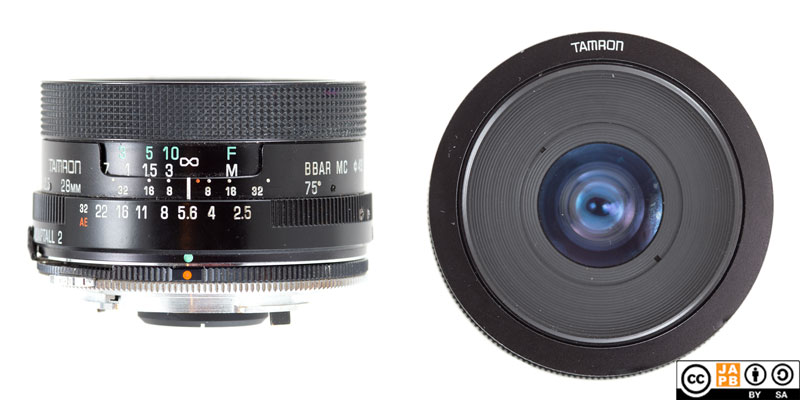
| 28 mm | f/2.8 | unknown | unclear | 7e / 7g | 0,25 m | 52 mm | 230g | 48/65 mm | F-system |
| 35 mm | f/2.8 | unknown | unclear | unknown | unknown | 55 mm | unknown | unknown | F-system |
| 135 mm | f/2.8 | unknown | unclear | 4e / 4g | 1,5 m | 55 mm | 360g | 73/65mm | F-system |
| 200 mm | f/3.5 | unknown | unclear | 4e / 3g | 2,5 m | 62 mm | 500g | 121/70mm | F-system |
| 300 mm | f/5.6 | unknown | unclear | 4e / 4g | 2,5 m | 58 mm | 580g | 167/68mm | F-system |
| 85-210 mm | f/4.5 | unknown | unclear | 12e / 10g | 1,8 m | 55 mm | 700g | 151/66mm | F-system |
Sometime in the 1970s Tamron launched the F-system – a series of lenses with fixed mounts for the then central SLR mounts (Canon FD, Konica AR, Minolta SR, M42, Nikon F, Olympus OM). This was likely a stopgap measure to address the relative handicaps of the (first generation) Adaptall mount. While brochures and other documentation on the F-system exists, some key information on these lenses (including model numbers and production dates) is currently unavailable. Production years of F-system lenses likely corresponds to that of similar Adaptall lenses, meaning 1976–79.
Footnotes
- Technically this is not true as Tamron in 1998 bought Zenza Bronica Kogyo Kabushiki Kaisha – makers of Zenza Bronica medium format cameras. What however distinguishes Tamron from many of its contemporary Japanese lens makers (e.g. Sigma or Cosina) is that Tamron seemingly was content in manufacturing lenses for use on other’s cameras. ↩︎
- Likely a successor for the ‘Taika Harigon’ 58/1.2 ↩︎
- Like the #680, this lens was supplied with a dedicated converter which made the lens a 225 mm f/7.7 ↩︎
- Some accounts indicate that the Tamron 400/6.9 could be separated into two parts (for more practical transportation?). Whether these accounts indicate that all versions of the Tamron 400/6.9 had this feature or whether there were two different versions of the 400/6.9 is unclear. ↩︎
- Seemingly there were three versions of the 21/4.5 lens that differed in their focus ring (from metal to rubber) and in how the aperture coupling was arranged. In terms of optical design and size, these versions seem to have been quite similar. ↩︎
- While sporting a 82 mm front filter ring, the lens also supported using rear filters (17 mm filter threads) ↩︎
- Seemingly there were three versions of the 35/2.8 lens that differed in their focus ring (from metal to rubber) and in how the aperture coupling was arranged. In terms of optical design and size, these versions seem to have been quite similar. ↩︎
- This lens is not widely documented (e.g. Tamron does not acknowledge it), but there are several user accounts to be found online, including [1] and [2] ↩︎
- Seemingly there were three versions of the 70-220/4 (PZ-30Au) lens that differed in their focus ring (from metal to rubber) and in how the aperture coupling was arranged. In terms of optical design and size, these versions seem to have been quite similar. ↩︎
- Seemingly there were three versions of the 80-250/3.8 (PZ-20Au) lens that differed in their focus ring (from metal to rubber) and in how the aperture coupling was arranged. In terms of optical design and size, these versions seem to have been quite similar. ↩︎
- Brochures indicate that an early version of this lens would have existed that used metal focus rings. ↩︎
- I have found no hard data on the date of introduction of the Tamron-F series of lenses, but 1973/74 is a good bet as early brochures show lenses that are outwardly similar to Adaptall lenses and the same brochures do mention compatibility with the OM-system (introduced 1972/73), but do not yet mention either the Pentax K or Contax/Yashica systems (introduced 1975) ↩︎
- There are at least three versions of this lens: one in black with a transparent ring over the focusing scale (and with a 55 mm filter diameter), one that is all-black and professes to be BBAR multicoated (52 mm filter thread) and a version of this second lens in light silver. ↩︎
- There are at least two versions of this lens: : one in black with a transparent ring over the focusing scale and one that is all-black and professes to be BBAR multicoated. Some sources say that the first version has a 9-bladed aperture. ↩︎
- This lens existed in both black and light silver. ↩︎
- This lens existed in both black and light silver. ↩︎
- This lens existed in both black and light silver. ↩︎
- This lens existed in both black and light silver. ↩︎
- This lens existed in both black and light silver. ↩︎
- This lens existed in both black and light silver. ↩︎
- Weight data in public sources is messy, as even sources that claim that they include the weight of an adapter might be without adapter. Hence, unless weight data is given in two figures (without/with), the data point might indicate either value. ↩︎
- Built-in filters selectable from a front ring. ↩︎
- Macro lens with maximum magnification 1:2 (1:1 with dedicated extension ring). ↩︎
- The 52BB is a cosmetic update on the 52B. ↩︎
- Front and rear filters. ↩︎
- Front and rear filters. ↩︎
- Front and rear filters. ↩︎
- Front and rear filters. ↩︎
- Front and rear filters. ↩︎
- the 55BB is a cosmetic update on the 55B. ↩︎
- When used with the (optional) #27FH lens hood, you could mount 77 mm filters in the hood ↩︎
- There was also an AF version of this lens (product code 159D) made for Nikon and Minolta AF mounts ↩︎
- There was also an AF version of this lens (product code 176D) made for Nikon, Canon and Minolta AF mounts. ↩︎
- There was also an AF version of this lens (product code 71D) made for Nikon, Canon, Pentax and Minolta AF mounts. ↩︎
- There was also an AF version of this lens (product code 171D) made for Nikon, Canon, Pentax and Minolta AF mounts. ↩︎
- There was also an AF version of this lens (product code 65D) made for Nikon, Canon and Minolta AF mounts. ↩︎
- This was the first compact telephoto zoom lens that featured softness control. ↩︎
- The 20AB is the same lens as the 20A, except the rotation direction of the focusing ring is reversed. ↩︎
- Special lens with integrated AF (using beam splitter) and internal focusing. ↩︎
- There was also an AF version of this lens (product code 158D) made for Nikon and Minolta AF mounts ↩︎
- Front and rear filters. ↩︎