Pekka Buttler, 12/2025
Kilfitt in brief
Heinz Kilfitt Optische Werke developed from a small specialist workshop into one of the most innovative German lens makers and camera designers of the post‑war era, before ending its life under the Zoomar name in the United States. Kilfitt never was a mass market brand – instead Kilfitt was well-known as the source of innovative designs and excruciatingly meticulous quality control.
Heinz Kilfitt
Few camera/optics companies are more strongly intertwined with their founder than Kilfitt. Heinrich Wilhelm (Heinz) Kilfitt was born in 1898 the son of a watchmaker in a townlet at the outskirts of modern-day Bochum (in the Ruhr coal mining area). From a young age he worked in his father’s shop repairing watches, while also taking an interest in photography. This combination of skills and interests would become central to his future endeavours.
Heinz Kilfitt the camera maker
Robot
In the early 1930s Heinz Kilfitt designed his first camera. It was based on the 135 format film, but unlike the contemporary Leica’s that took 3:2 images (36×24 mm), Kilfitt’s design to square (1:1) images using 24×24 mm of the film. The square format allowed over 50 exposures on a standard 36 exposure film, but that was not the most outstanding feature of Kilfitt’s design. The camera was a clockwork camera! Instead of winding the camera between exposures, the camera’s spring could be wound in advance, allowing 4 frames per second continuous shooting until the spring was depleted.
After having had his design rejected by Kodak (Germany) and Agfa, Kilfitt managed to find a patron in Hans Berning, who set up a company to manufacture the camera christened the ‘Robot’. The Robot cameras were manufactured in several versions from 1934, ending with a collector’s model that was manufactured in 1996. While Kilfitt was the sole designer of only the Robot I camera, most subsequent models build so extensively on Kilfitt’s original model, that Kilfitt can be seen as one of the designers for even later Robot cameras.
Metz Mecaflex
Kilfitt designed the Mecaflex – a square format (24×24 mm)leaf shutter interchangeable lens camera – for the Metz consumer electronics company. While the Mecaflex in some ways was an extension of the Robot (square format), it also was a forerunner of a later trend. In many ways the Mecaflex was very much like the Zeiss Ikon Contaflex (introduced 1953), Kodak Retina Reflex (1956) and Voigtländer Bessamatic (1959), except that the Mecaflex (introduced at Photokina in 1951) preceeded them.
Metz manufactured the Mecaflex until 1958, whereafter Kilfitt took over manufacturing at the SEROA plant in Monaco until 1965. The Mecaflex made extensive use of Kilfitt lens designs.
Kowa Six
Some sources say that Heinz Kilfitt also was the original designer of the Kowa Six medium format interchangeable lens SLR, but this claim is not rock-solid and I will not explore it further.
Heinz Kilfitt – Lensmaker
Kilfitt acquired an optics plant in Munich around 1940, renamed it and expanded it and started manufacturing lenses in 1941 at the ‘Heinz Kilfitt Optishe Fabrik’ in Munich, Germany. At that stage civilian industries were already strongly curtailed, so this move into lensmaking was likely extensively inspired by the war effort. After the extensive devastation wrought on Munich at the end of WWII, Kilfitt in 1947 founded a second factory in Vaduz, in Liechtenstein.
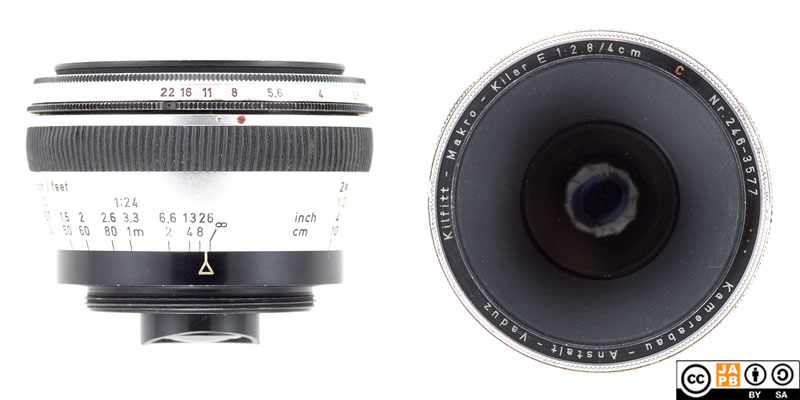
Tele-Kilar
Around 1948 Kilfitt launched its line of ‘Kilar’ lenses for a wide range of cameras. Initially Kilfitt specialised in Tele lenses, starting with moderate Tele lenses (135–150 mm) and longish tele lenses (300 mm) before expanding into extreme tele lenses (400-600 mm).
Macro-Kilar
In the early 1950s Kilfitt stumbled upon an underserved niche and started manufacturing lenses that could be used as macro lenses without the use of a bellows. Previously life size (1:1) macro invariably necessitated either bellows, adjustable extension rings or close-up lenses (or a combination of these). Such approaches not only were far from hassle-free, they also typically necessitated a specialised rig and stable circumstances for photography. Kilfitt launched a series of ‘Macro-Kilar’ lenses that could be used both in normal landscape photography (i.e. they could be focused to infinity) as well as in semi-serious macro work (1:2 or 1:1 maximum magnification without any added extension rings or bellows).
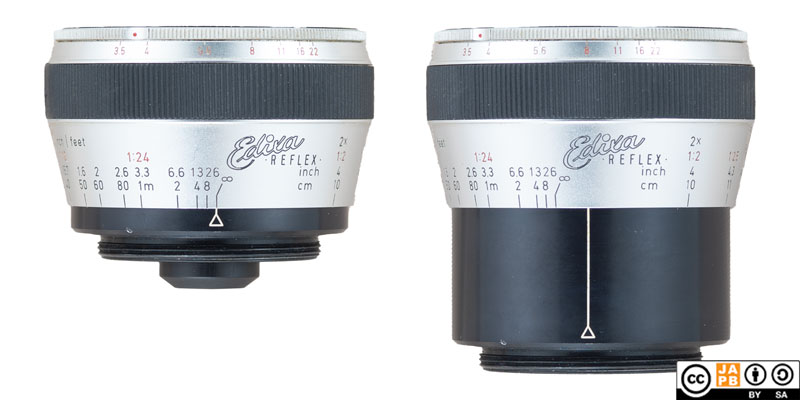
Right: Kilfitt Makro-Kilar 40 mm f/3.5 (M42 mount) focused at MFD
Quality assurance to the max
Quality assurance was always a key function for any company that wanted to be taken seriously by professionals, but one can argue that Kilfitt took QA to the next level. To quote from a now-defunct website:
“Every Kilfitt lens was tested before leaving the factory. Film was not considered flat enough for accurate tests, so it was shot on glass plates — two of them. One plate went out with the lens, the other stayed at the factory for future comparisons if the lens was ever returned for repairs. The lenses were bolted to a tripod head mounted in concrete in the basement of the Kilfitt factory. Mr. Kilfitt wanted to turn out quality lenses, and he did.” (Source)
Zoom
It was likely Kilfitt’s attention to workmanship and quality that got the attention of a Dr. Frank G. Back. Dr. Back had designed the first zoom lens for 35 mm still photography (the 36-82/2.8 Zoomar), but had not found a company that Back could trust with the manufacture of the lens – until Kilfitt, that is. When Voigtländer in 1956 launched its Bessamatic leaf shutter SLR (see more in the JAPB article on the DKL mount) and they showed an interest in licensing Dr. Beck’s design, Kilfitt München started manufacturing the Zoomar – initially for the DKL mount, but later also for the Exakta mount.
Mounts
As a small, independent lens manufacturer, Heinz Kilfitt was well aware that being able to bridge a wider range of mounts was key to being competitive. In this Kilfitt employed a dual strategy:
The 40 mm Makro-Kilars1 was designed to easily be fitted with a wide range of different mounts, and you could order it (from your local retailer) with a broad range of alternative mounts (including: Canon R, Contarex, Exakta, Minolta SR, Miranda, M42 and C-mount). Should you however later decide to switch systems, you took your lens to the retailer who would have the mount switched (the mount was not intended to be user-replaceable).
Adapters
Longer Kilfitt lenses (those that could typically accommodate a lot of empty space between the rearmost lens element and the film plane), meaning all but the 40 mm Macro-Kilar offered a wide range of adapters to a broad range of systems, including (based on Kilfitt brochures2):
35 mm mounts:
• Alpa, Canon R, Contarex, Exakta (and Topcon RE), Leica M, LTM, Minolta SR, Miranda, M42, Nikon F, Praktina
Medium format mounts:
• Hasselblad V, Pentacon Six, Primarflex
(As well as several cinema mounts)
Importantly, there was not one Kilfitt adapter per mount but four (!). This was based partially on that different adapters supplied different functionalities, but also because of different distances to be bridged (from rear of lens to focal plane). The four types of adapters were:
• Adapters for the 90 mm Makro-Kilar. These were named “tum…” and “re…” (“tum…” adapters offered a variable extension and a tripod socket)
• DeLuxe adapters for 135–300 mm Kilars and Tele-Kilars for general photography (from infinity to indicated MFD). Most of these were named “kil…” or “kit…” and offered gelatin filter holders and tripod sockets.
• Macro adapters for 135–300 mm Kilars and Tele-Kilars for general photography and macro work (from infinity to closer than MFD). These were named “tul…” and offered gelatin filter holders and tripod sockets.
• Flange adapters to be used with the 300 mm Pan-Kilar or longer lenses for general photography (from infinity to MFD). These were named “an…” and offered gelatin filter holders and tripod sockets.
As a result, you could not reuse the adapter for (your system) from your 90 mm Makro-Kilar to your (300mm Tele-Kilar), but you could switch adapters among your 135 mm Kilar and 300 mm Tele-Kilar. To make matters (slightly) worse, not all types of adapters were available for exactly every system.
Kilfitt Zoomar
After Heinz Kilfitt retired in 1964 the company was run by Dr. Haeberlein for a couple of years before being acquired by Zoomar in 1966. Thereafter production of remaining lens designs was gradually moved to Zoomar’s Long Island (U.S.) plant. Under the Zoomar stewardship most remaining Kilfitt designs were sold under the Zoomar brand.
Zoomar left the consumer optics business in the 1986 to focus on military optics.
Adapting Kilfitt lenses
It all depends on which mount your Kilfitt lens comes with.
In the case of the 40 mm Makro-Kilar’s your first order of business is to see which mount your copy of the Makro-Kilar sports and then find the adapter to your system. If your system is a mirrorless system, you will almost3 certainly be able to find an adapter whereas if you intend to use the lens on an SLR/dSLR , you might find your options more limited.
In the case of all the longer Kilfitt lenses, you need to start by figuring out which adapter the lens currently sports. For this you can either use the JAPB guide to identifying your lens mount or use the table below (Kilfitt adapters usually sport the adapter type name) . In some cases (e.g. Nikon F adapters) you will have no trouble adapting your Kilfitt lens to your camera, whereas in some other cases (e.g. Alpa adapters), you might be better served by finding a more easily adapted Kilfitt adapter.
Kilfitt adapter table
There are two adapter tables, one applies to earlier (until roughly 1963) adapters whereas the later reflects changes in both the Kilfitt lens lineup as well as typically used mounts.
ca. 1954–1962
| adapter for 90 mm Makro-Kilar (double helicoid version)4 | regular adapter for 135–150 Kilar and 300 mm Tele-Kilar | helicoid adapter for 135–150 Kilar and 300 mm Tele-Kilar | Flange adapter for 300 Pan-Tele, 400 Fern or 400–600 Sport-Fern | |
| Alpa | tumal | kilal | tulal | anal |
| Canon R | tumca | kilca | tulca | anca |
| Contarex | tumco | kilco | tulco | anco |
| Exakta (and Topcon RE) | tumex | kilex | tulex | anex |
| LTM | rexop † | repor † | – – | anspi with rexop † |
| Leica M | repem † | repmo † | – – | anspi with repem † |
| Leica with Visoflex I | – – | cozwi | – – | anso |
| Leica with Visoflex II/IIa | revis | kivis | – – | anvis |
| Minolta SR | tumol | kilol | tulol | anol |
| Miranda | tummi | kilmi | kulmi | anmi |
| M42 | tumpa | kilpa | tulpa | anpa |
| Nikon F | tumni | kilni | tulni | anni |
| Novoflex | – – | cozwi | – – | anso |
| Praktina | retin / tutin | kitin | – – | antis |
| Rectaflex | tumre | kilre | tulre | anre |
| Hasselblad 1000/1600 | nemha ** | – – | – – | anhas |
| Primarflex | nempi ** | – – | – – | anpri |
| Pentacon Six | nemsi ** | – – | – – | ansix |
| Reflex Korelle | nemko ** | – – | – – | – – |
| Arriflex | tubar !! | kizar!! | tubar !! | anzar !! |
| CineKodak Special | rekod | kikod | – – | ansic, kikod |
| C-mount | tumci | kilci | tulci | anci |
Notes to table
† With Kilarscope Prism reflex housing
** No adapter, but Makro-Kilar 90 mm could be custom made (on order) for Medium format mounts.
!! Arri adapters to Kilfitt lenses were only sold by Arri and do hence not follow the same nomenclature.
From Ca. 1962
| Macro-Zoomatar 40/2.8 *** | Macro-Zoomar 50–127/4 | Sport-Fern-Kilar 400/4 and 600/5.6 as well as Sport-Reflectar 500/5.6 (SPIFU) | Macro-Kilar 90/2.8, Reflectar 250/4, Sport-Reflectar 500/5.6 (SPIFS), and Pan-Tele-Kilar 300/4 | Reflectar 1000/8 | |
| CINE | |||||
| C-mount | VIDCI | – – | WE CIN | WE CIN | CIN |
| D-mount | VIDBO | – – | WE BON | WE BON | BON |
| Arriflex | VIDAR | – – | WEAR | WEAR | WEAR |
| 35 mm Film | |||||
| M42 | VIDEO | PAN | WE PAN | WE PAN | PAN |
| Exakta & Topcon | VIDEX | EXN | WE EXN | WE EXN | ENX |
| Alpa | VIDAL | ALN | WE ALN | WE ALN | ALN |
| Canon FL | VIDCA | CAN | WE CAN | WE CAN | CAN |
| Contarex | VIDCO | CON | WE CON | WE CON | CON |
| Icarex | VIDIC | ICN | WE ICN | WE ICN | ICN |
| Leica R | – – | LEN | WE LEN | WE LEN | LEN |
| Minolta SR | VIDOL | OLN | WE OLN | WE OLN | OLN |
| Miranda | VIDMI | MIN | WE MIN | WE MIN | MIN |
| Nikon | – – | NIN | WE NIN | WE NIN | NIN |
| Olympus OM | VIDLY | LYN | WE LYN | WE LYN | LYN |
| Petri | VIDPI | PIN | WE PIN | WE PIN | PIN |
| Praktina | VITIN | TIN | WE TIN | WE TIN | TIN |
| Konica AR | VIDAU | W | WE AUN | WE AUN | AUN |
| Kilarskop/ Kilarflex | – – | – – | WEKI | WEKI | WEKI |
| Visoflex II & III | – – | – – | WEVI | WEVI | WEVI |
| Medium format | |||||
| Hasselblad 1000/1600 | – – | – – | – – | WEHA5 | WEHA |
| Pentacon Six | – – | – – | – – | WESI | WESI |
| Rittreck / Revue Six / Norita 66 | – – | – – | – – | WERI | WERI |
| Kalimar | – – | – – | – – | WELI | WELI |
| Bronica | – – | – – | – – | 90/2.8 => NEMBR; Reflectar 250/4 => ZWEBR; Pan-Tele Kilar 300/4 => PASBR; Sport-Reflectar 500/5.6 => FUEBR | SPIBR |
| Rollei SL66 | – – | – – | – – | 90/2.8 => NEMRO; Pan-Tele Kilar 300/4 => PANRO | TAURO |
Back to the listing of all JAPB company profiles
Footnotes
- There were 2 variants of the Macro Kilar: The model E that supported 1:2 maximum magnification and the model D that supported 1:1 maximum magnification. ↩︎
- This means that while Kilfitt at some stage offered all these adapters, the modern-day availability of some of these adapters is very heavily constrained. ↩︎
- Availability of Miranda adapters remains constrained. ↩︎
- The adapter code for the triple helicoid version is in parentheses. ↩︎
- Only usable on Makro-Kilar 90/2.8 and Pan-Tele Kilar 300/4 ↩︎
Sources
• https://en.wikipedia.org/wiki/Heinz_Kilfitt
• https://camera-wiki.org/wiki/kilfitt
• https://camera-wiki.org/wiki/Heinz_Kilfitt
• https://stichtinghistorischemicroscopie.nl/en/category/kilfitt-en/
• https://en.wikipedia.org/wiki/Robot_(camera)
• http://www.praktina.com/pulen08.htm
• https://www.cameraquest.com/kilzoom.htm
• http://www.novacon.com.br/odditycameras/metzmeca.htm
• https://en.wikipedia.org/wiki/Zoomar_lens
• https://pentaconsix.com/ptk.htm
• https://web.archive.org/web/20180503024806/http://www.kilfitt.org/Cameras/Kowa.htm
• Kilfitt brochures