Pekka Buttler (March 2026)
Introduction
In searching for sources on Miranda lenses (and cameras), I’ve noticed that a lot of the data to be found online is incomplete, often incorrect and repeated ad nauseam. Hence, it felt like a worthwhile contribution to put together a compendium of Miranda lenses.
This compendium focuses on lenses for Miranda cameras that had ‘Miranda’ in the name (it does not cover post-1976 Cosina lenses sold by UK photo retailer Dixon’s under the Miranda brand (see more about that episode here) nor lenses by other manufacturers for the Miranda mount (unless the lens’ name contains ‘Miranda’).
P.S. Miranda was a camera manufacturer and not a lens manufacturer. Lenses branded as “Miranda” were not manufactured by Miranda, but were sourced from other manufacturers and branded ‘Miranda’. Most often these lenses were sourced from Miranda’s long-time partner (and later: owner) Soligor (Allied Impex Corporation). Hence, the actual manufacturer of “Miranda” lenses is often impossible to discern with certainty.
Miranda lens generations
To clarify the compendium below, I’ve grouped Miranda lenses into the following families:
M/P
Manual and preset lenses. The earliest lenses for the Miranda system were introduced as early as 1955 and either were fully manual lenses or preset lenses. Even later Miranda kept offering some preset lenses.
PAD
PAD stands for “Pressure-Activated Diaphragm”. These were lenses that had “pods” that rested above the Miranda camera’s front-facing shutter button. To take a picture you would press a button at the front of the pod, this would stop down the lens before (in turn) pressing the shutter button.
MEX-REX
In 1960 Miranda introduced the Miranda Automex. This camera offered two state of the art features: Auto Aperture and Aperture communication (for metering purposes).
• Auto aperture: The Automex had a lever (within the mount) that would stop down a compatible lens for the shot and allow the aperture back up again after the shot.
• Aperture communication: The Automex camera (and compatible lenses) had an external aperture communication arm that would allow the lens to tell the body the selected aperture.
The 1960 Automex was followed by versions II and III and was replaced in 1966 by the Sensorex (which used the same lenses). The Sensorex was followed by the Sensorex-C and Sensorex II.
These lenses are often referred to as “For Sensorex” lenses.
F-G-MAT
The 1963 Miranda F was intended as the more affordable alternative to the Automex line and while it used the same method for facilitating Auto aperture as the MEX-REX series of lenses it did not make use of the MEX-REX lenses’ ability to communicate aperture information. Hence, Miranda gradually started offering a separate series of lenses for the Miranda F and its successors: the FM, Fv, G and the Sensomat series.
These lenses are often referred to as “For Sensomat” lenses.
E
In 1972 Miranda introduced the Auto Sensorex EE camera that did introduced a new method for the lens to communicate the selected aperture to the camera, using a second lever inside the mount. Miranda called these lenses the “E” lenses, hence so do we.
EC1
In 1974 Miranda decided to redesign its lens lineup, aiming for overall more compact lenses. In terms of abilities EC lenses are E lenses.
DUAL
In tandem with the introduction of EC lenses, Miranda also discontinued the MEX-REX and F-G-MAT lineup of lenses (that had been left in the lineup for compatibility) and instead introduced a lineup of lenses referred to as the “Auto Dual” lenses. Some of these lenses were earlier Miranda “E” lenses whereas other lenses were from Soligor’s lens arsenal. All of these lenses could be ordered in accordance to F-G-MAT spec and most could also be ordered fitted with an external aperture coupling arm (for compatibility with the MEX-REX -line).
| Generation | Years | Auto-aperture | Aperture communication | For cameras | Compatible cameras | Notes |
|---|---|---|---|---|---|---|
| M/P | 1955–64 | None | None | T, T-II, A, B, ST, S, C, D, DR | All but Sensomat TM2 | 3 |
| PAD | 1957–64 | With PAD | None | T, T-II, A, B, ST, S, C, D, DR | All with front shutter button4 | 5 |
| MEX-REX | 1960-72(74) | Lever in mount | External aperture coupling arm | Automex, Automex II, Automex III, Sensorex, Sensorex-C, Sensorex II | All with stop-down lever in mount6 | 7 |
| F-G-MAT | 1963-72(74) | Lever in mount | None | F, FM, Fv, FvT, G, GT, Sensomat, Sensomat RE, Sensomat RS, | All with stop-down lever in mount | 8 |
| E | 1972-74(76) | Lever in mount | Lever in mount | Auto Sensorex EE, dx-3, RE-II, EE-2 | All with stop-down lever in mount | 9 |
| EC | 1974-76 | Lever in mount | Lever in mount | Auto Sensorex EE, dx-3, RE-II, EE-2 | All with stop-down lever in mount | |
| DUAL | 1974-76 | Lever in mount | None, or external aperture coupling arm | As MEX-REX (with external arm) or as F-G-MAT (when no external arm) | See above. | 10 |
Miranda lens compendium
All data based on Miranda documentation (except underlined numbers are based on measured samples)
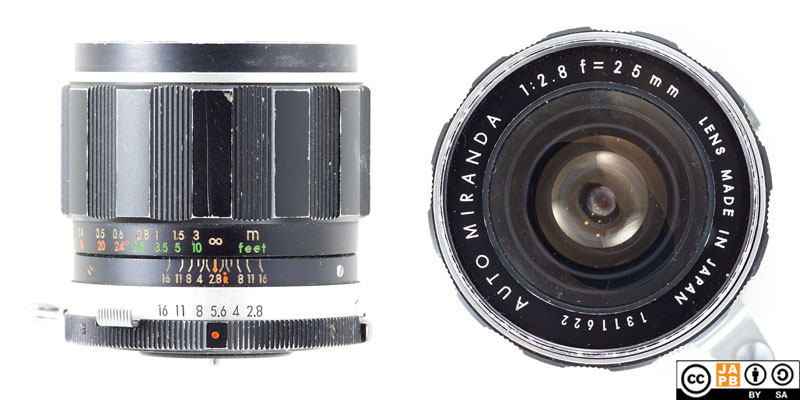
17–27 mm
Only a few wider than 28 mm lenses were available, and especially the ultra-wides were a late addition to the lineup.
| Mainline spec | Years | Generation | Recipe | MFD | Filter | Length | Diameter | Weight | Notes |
|---|---|---|---|---|---|---|---|---|---|
| 17 mm f/4 | 1974–76 | DUAL | 11e / 10g | 0,3 m | 72mm | 89 mm | unknown | 450 g | 11 |
| 21 mm f/3.8 | 1974–76 | DUAL | 9e / 8g | 0,25 m | 72mm | 57 mm | unknown | 285 g | 12 |
| 25 mm f/2.813 | 1970–1974 | MEX-REX | 8e / 7g | 0,25m | 52mm | 57 mm | 59 mm | 274 g | [data sheet] |
| 25 mm f/2.8 | 1970–1974 | F-G-MAT | 8e / 7g | 0,25 m | 52mm | 60mm | 59 mm | 300 g | |
| 25 mm f/2.8 | 1972–1976 | E | 8e / 7g | 0,25 m | 52mm | 60 mm | 59 mm | 300 g | |
| 25 mm f/2.8 | 1974–76 | DUAL | 8e / 7g | 0,25 m | 52mm | 57 mm | unknown | 300 g |
28 mm
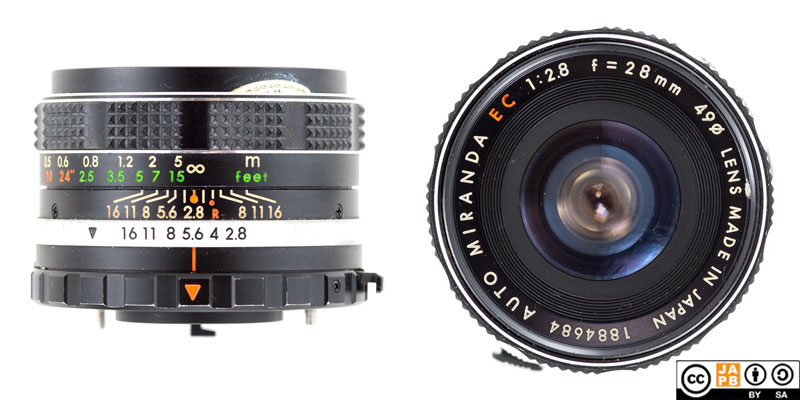
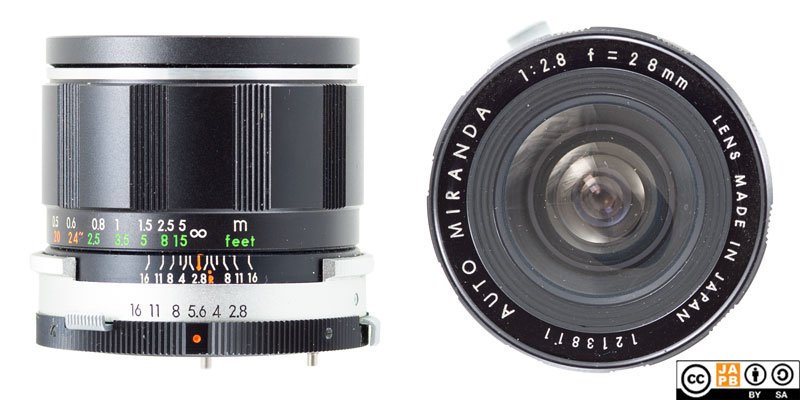
28 mm wide-angles were an obvious requirement for any self-respecting system.
| Mainline spec | Years | Generation | Recipe | MFD | Filter | Length | Diameter | Weight | Notes |
|---|---|---|---|---|---|---|---|---|---|
| 28 mm f/2.8 | 1960–63 | unknown | 8e | unknown | unknown | unknown | unknown | unknown | 14 |
| 28 mm f/2.8 | 1963–74 | F-G-MAT | 8e / 6g | 0,25 m | 46 mm | 58 mm | 59 mm | 230 g | |
| 28 mm f/2.8 | 1963–74 | MEX-REX | 8e / 6g | 0,25 m | 46 mm | 60 mm | 59 mm | 232 g | |
| 28 mm f/2.8 | 1972–74 | E | 8e / 6g | 0,25 m | 52 mm | 54 mm | 59 mm | 273 g | |
| 28 mm f/2.8 | 1974–76 | EC | 7e / 7g | 0,25 m | 49 mm | 40 mm | 60 mm | 205 g | [data sheet] |
| 28 mm f/2.8 | 1974–76 | Dual | 8e / 6g | 0,25 m | 52 mm | 53 mm | 59 mm | 219 g | [data sheet] |
35 mm
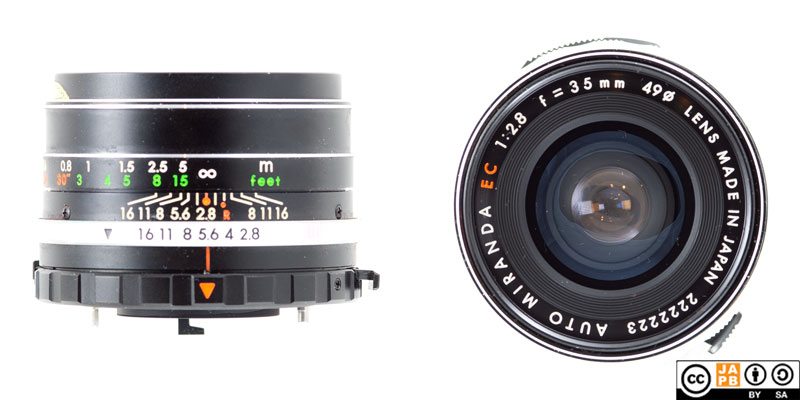
The first 35 mm wide-angles were seemingly very rare, but from 1963 onward the models are readily available.
| Mainline spec | Years | Generation | Recipe | MFD | Filter | Length | Diameter | Weight | Notes |
|---|---|---|---|---|---|---|---|---|---|
| 35 mm f/3.5 | 1960–64 | M/P | 6e | unknown | unknown | unknown | unknown | unknown | 15 |
| 35 mm f/2.8 | 1960–64 | unknown | 7e | unknown | unknown | unknown | unknown | unknown | 16 |
| 35 mm f/2.8 | 1963–74 | F-G-MAT | 6e / 5g | 0,3 m | 46 mm | 48 mm | 58 mm | 198 g | |
| 35 mm f/2.8 | 1966–74 | MEX-REX | 6e /5g | 0,3 m | 46 mm | 48 mm | 59 mm | 222 g | |
| 35 mm f/2.8 | 1972–74 | E | 6e /5g | 0,3 m | 52 mm | 49 mm | 58 mm | 222 g | |
| 35 mm f/2.8 | 1974–76 | EC | 6e /6g | 0,3 m | 49 mm | 40 mm | 60 mm | 192 g | [data sheet] |
| 35 mm f/2.8 | 1974–76 | DUAL | 6e /5g | 0,3 m | 52 mm | 65 mm | unknown | 222 g |
50 mm
You cannot have a camera system without several standard lenses to choose from.
| Mainline spec | Years | Generation | Recipe | MFD | Filter | Length | Diameter | Weight | Notes |
|---|---|---|---|---|---|---|---|---|---|
| 50 mm f/2.8 | 1955–63 | M/P | 5e | unknown | unknown | unknown | unknown | unknown | 17 |
| 50 mm f/1.9 | 1959–60 | PAD | unknown | 0,45 m | unknown | unknown | unknown | unknown | 18 |
| 50 mm f/1.9 | unknown | PAD | 6e / 4g | 0,45 m | 46 mm | unknown | unknown | unknown | 19 |
| 50 mm f/1.9 | 1960–63 | MEX-REX | 6e / 4g | 0,43 m | 46 mm | 42 mm | 58 mm | unknown | Soligor Miranda 20 |
| 50 mm f/1.9 | 1964–70 | MEX-REX | 6e / 4g | 0,43 m | 46 mm | 42 mm | 58 mm | unknown | |
| 50 mm f/1.9 | 1963–68 | F-G-MAT | 6e / 4g | 0,43 m | 46 mm | 42 mm | 58 mm | 193 g | [data sheet] |
| 50 mm f/1.8 | 1970–74 | MEX-REX | 6e / 4g | 0,43 m | 46 mm | 47 mm | 59 mm | 235 g | 21 |
| 50 mm f/1.8 | 1968–74 | F-G-MAT | 6e / 4g | 0,43 m | 46 mm | 42 mm | 59 mm | 203 g | [data sheet] |
| 50 mm f/1.8 | 1972–74 | E | 6e / 4g | 0,43 m | 52 mm | 47 mm | 59 mm | 235 g | |
| 50 mm f/1.8 | 1974–76 | EC | 6e / 4g | 0,43 m | 49 mm | 43 mm | 60 mm | 218 g | [data sheet] |
| 50 mm f/1.8 | 1974–76 | DUAL | 6e / 4g | 0,43 m | 52 mm | 51 mm | unknown | 226 g | |
| 50 mm f/1.4 | 1966–72 | MEX-REX | 8e / 6g | 0,43 m | 46 mm | unknown22 | unknown | unknown | |
| 50 mm f/1.4 | 1968–74 | F-G-MAT | 8e / 6g | 0,43 m | 46 mm | 51 mm | 60 mm | 301 g | [data sheet] |
| 50 mm f/1.4 | 1972–74 | MEX-REX | 7e / 5g | 0,43 m | 52 mm | 55 mm | 63 mm | 345 g | 23 |
| 50 mm f/1.4 | 1972–74 | E | 7e / 5g | 0,43 m | 52 mm | 55 mm | 63 mm | 345 g | |
| 50 mm f/1.4 | 1974–76 | EC | 7e / 5g | 0,43 m | 49 mm | 45 mm | 61 mm | 278 g | [data sheet] |
| 50 mm f/1.4 | 1974–76 | DUAL | 7e / 5g | 0,43 m | 52 mm | 55 mm | 63 mm | 345 g |
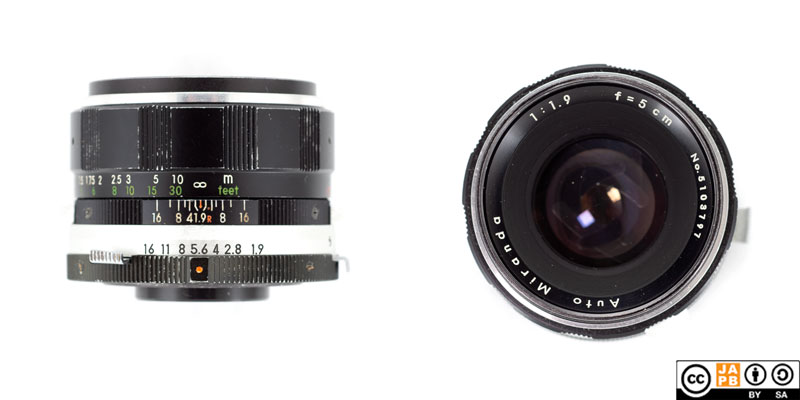
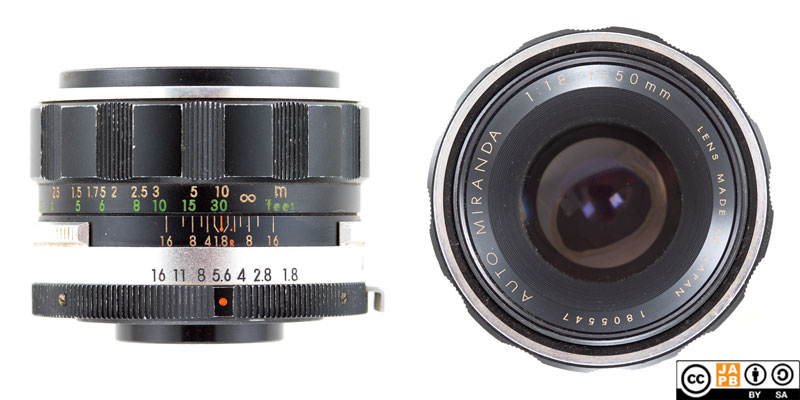
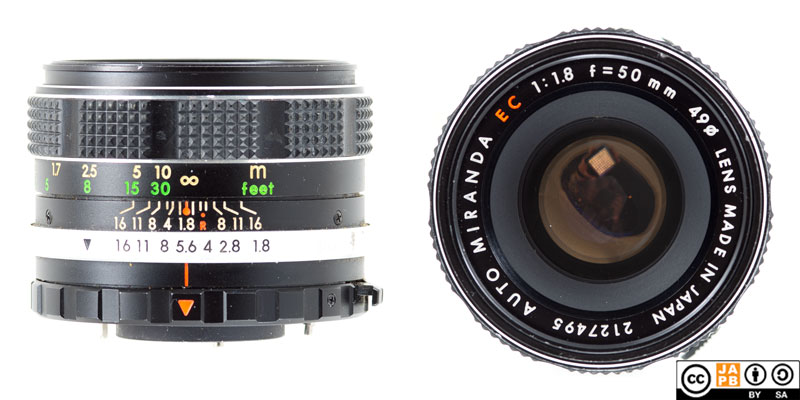
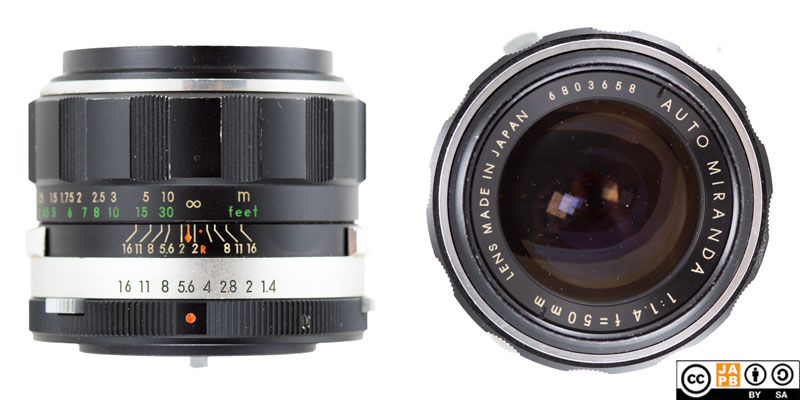
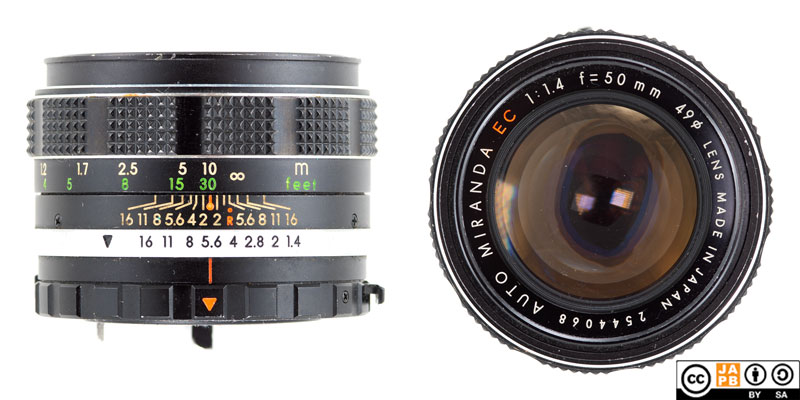
Please note: Especially in the early days of the Miranda system a lot of interesting (and often rare) lenses were offered that did not feature the name ‘Miranda’, including:
• Arco 50 mm f/2.4 (44 mm thread mount, preset lens)
• Zunow 50 mm f/1.9 (44 mm thread mount, preset lens)
• Ofunar 50 mm f/1.9 (44 mm thread mount, preset lens)
58–85 mm
Only a few lenses were available between 50 and 105 mm and all of them are very rare.
| Mainline spec | Years | Generation | Recipe | MFD | Filter | Length | Diameter | Weight | Notes |
|---|---|---|---|---|---|---|---|---|---|
| 58 mm f/2 | 1957 | PAD | unknown | unknown | unknown | unknown | unknown | unknown | |
| 58 mm f/1.5 | 1960 | PAD | 7e / 5g | 0,45 m | unknown | unknown | unknown | 417 g | Soligor Miranda24 |
| 85 mm f/1.8 | 1960 | MEX-REX | 6 e | unknown | unknown | unknown | unknown | unknown | 25 |
105 mm
Instead of 85 mm, Miranda chose 105 mm as its go-to focal length for short teles.
| Mainline spec | Years | Generation | Recipe | MFD | Filter | Length | Diameter | Weight | Notes |
|---|---|---|---|---|---|---|---|---|---|
| 105 mm f/2.8 | 1956 | M/P | 4 e / 4g | 1,07 m | unknown | unknown | unknown | 450 g | Orion / Miranda Supreme26 |
| 105 mm f/2.8 | 1960–68 | Unknown | 5 e | unknown | unknown | unknown | unknown | unknown | 27 |
| 105 mm f/2.8 | 1963–66 | MEX-REX | 6e | unknown | unknown | unknown | unknown | unknown | 28 |
| 105 mm f/2.8 | 1966–74 | MEX-REX | 5e / 5g | 1,2 m | 46 mm | 69 mm | 59 mm | 340 g | |
| 105 mm f/2.8 | 1968–74 | F-G-MAT | 5e / 5g | 1,2 m | 46 mm | 69 mm | 59 mm | 335 g | |
| 105 mm f/2.8 | 1972–74 | E | 5e / 5g | 1,2 m | 52 mm | 69 mm | 59 mm | 340 g | |
| 105 mm f/2.8 | 1974–76 | EC | 5e / 5g | 1,2 m | 49 mm | 64 mm | unknown | 315 g | |
| 105 mm f/2.8 | 1974–76 | DUAL | 5e / 5g | 1,2 m | 52 mm | 69 mm | unknown | 340 g |
135 mm
There was no lack of 135 mm Miranda lenses (and at times there were so many simultaneous offerings that one is easily confused.
| Mainline spec | Years | Generation | Recipe | MFD | Filter | Length | Diameter | Weight | Notes |
|---|---|---|---|---|---|---|---|---|---|
| 135 mm f/3.5 | 1959 | M/P | unknown | unknown | unknown | unknown | unknown | unknown | 29 |
| 135 mm f/3.5 | 1960–64 | unknown | unknown | unknown | unknown | unknown | unknown | unknown | 30 |
| 135 mm f/3.5 | 1960–64 | M/P | 5 e | unknown | unknown | unknown | unknown | unknown | 31 |
| 135 mm f/3.5 | 1960–64 | unknown | 6 e | unknown | unknown | unknown | unknown | unknown | 32 |
| 135 mm f/3.5 | 1963–68 | F-G-MAT | 4e / 3g | 1,5 m | 46 mm | 95 mm | 58 mm | 411 g | |
| 135 mm f/3.5 | 1968–1972 | F-G-MAT | 4e / 3g | 1,5 m | 46 mm | 94 mm | 60 mm | 410 g | |
| 135 mm f/3.5 | 1966–74 | MEX-REX | 4e / 3g | 1,5 m | 46 mm | 96 mm | 60 mm | 435 g | |
| 135 mm f/3.5 | 1972–76 | E | 4e / 3g | 1,5 m | 52 mm | 95 mm | 60 mm | 435 g | |
| 135 mm f/3.5 | 1974–76 | DUAL | 4e / 3g | 1,5 m | 52 mm | 95 mm | unknown | 400 g | |
| 135 mm f/2.8 | 1960–64 | unknown | 6e | unknown | unknown | unknown | unknown | unknown | 33 |
| 135 mm f/2.8 | 1960–64 | M/P | 5e | unknown | unknown | unknown | unknown | unknown | 34 |
| 135 mm f/2.8 | 1963–68 | F-G-MAT | 5e / 5g | 1,7 m | 55 mm | 95 mm | 63 mm | 492 g | |
| 135 mm f/2.8 | 1968–74 | F-G-MAT | 5e / 5g | 1,7 m | 55 mm | 94 mm | 67 mm | 480 g | |
| 135 mm f/2.8 | 1960–66 | MEX-REX | 6e | unknown | unknown | unknown | unknown | unknown | 35 |
| 135 mm f/2.8 | 1966–74 | MEX-REX | 5e / 5g | 1,5 m | 55 mm | 95 mm | 65 mm | 500 g | |
| 135 mm f/2.8 | 1972–74 | E | 5e / 5g | 1,5 m | 58 mm | 95 mm | 65 mm | 500 g | |
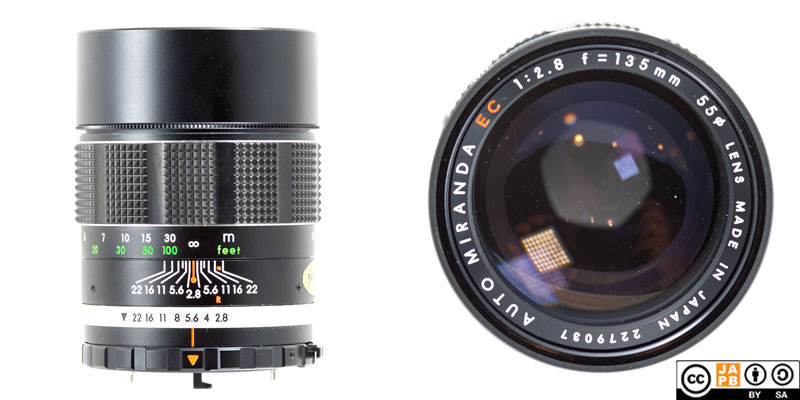
| 135 mm f/2.8 | 1974–76 | EC | 5e / 4g | 1,5 m | 55 mm | 85 mm | 62 mm | 356 g | [data sheet] |
| 135 mm f/2.8 | 1974–76 | DUAL | 5e / 5g | 1,5 m | 55 mm | 95 mm | unknown | 500 g |
180–200 mm
Both 180 and 200 mm tele lenses were in the lineup since 1972.
| Mainline spec | Years | Generation | Recipe | MFD | Filter | Length | Diameter | Weight | Notes |
|---|---|---|---|---|---|---|---|---|---|
| 180 mm f/3.5 | 1972–76 | MEX-REX | 4e / 4g | 2,3 m | 58 mm | 143 mm | 69 mm | 728 g | |
| 180 mm f/3.5 | 1972–76 | E | 4e / 4g | 2,3 m | 58 mm | 143 mm | 69 mm | 728 g | |
| 180 mm f/3.5 | 1974–76 | DUAL | 4e / 4g | 2,3 m | 58 mm | 143 mm | 69 mm | 728 g | 36 |
| 200 mm f/3.5 | 1970–74 | F-G-MAT | 6e / 5g | 3 m | 67 mm | 158 mm | 75 mm | 770 g | |
| 200 mm f/3.5 | 1972–74 | MEX-REX | 6e / 5g | 3 m | 62 mm | 150 mm | 70 mm | 760 g | |
| 200 mm f/3.5 | 1972–74 | E | 6e / 5g | 3 m | 62 mm | 150 mm | 70 mm | 760 g | |
| 200 mm f/3.5 | 1974–76 | EC | 6e / 5g | 2,5 m | 62 mm | 117 mm | unknown | 650 g | |
| 200 mm f/3.5 | 1974–76 | DUAL(MEX-REX) | 5e/ 4g | 3 m | 62 mm | 121 mm | unknown | 620 g | |
| 200 mm f/3.5 | 1974–76 | DUAL(F-G-MAT) | 5e/ 4g | 3 m | 62 mm | 159 mm | unknown | 770 g |
over 200 mm
Miranda did not emphasise long tele lenses in the way that some of its competitors did.
| Mainline spec | Years | Generation | Recipe | MFD | Filter | Length | Diameter | Weight | Notes |
|---|---|---|---|---|---|---|---|---|---|
| 250 mm f/4.5 | 1960–64 | M/P | unknown | unknown | unknown | unknown | unknown | unknown | 37 |
| 300 mm f/5.6 | 1974–76 | DUAL | 5e / 3g | 6 m | 62 mm | 168 mm | unknown | 860 g | 38 |
| 400 mm f/5.5 | 1960–64 | M/P | unknown | unknown | unknown | unknown | unknown | unknown | 39 |
Zooms
Towards the end of Miranda also some zooms were added to the ‘Miranda’ lineup (Soligor zooms (and other zooms) had been available for the Miranda mount for some time.)
| Mainline spec | Years | Generation | Recipe | MFD | Filter | Length | Diameter | Weight | Notes |
|---|---|---|---|---|---|---|---|---|---|
| 80–200 mm f/3.5 | 1974–76 | EC | 12e / 8g | 2 m | 62 mm | 183 mm | unknown | 910 g | 40 |
| 90–230 mm f/4.5 | 1974–76 | DUAL | 11e / 7g | 2,5 m | 58 mm | 210 mm | unknown | 960 g | 41 |
Macro lenses
Miranda originally bet on using bellows for macro work, but in the 1970s even dedicated macro lenses were offered.
| Mainline spec | Years | Generation | Recipe | MFD | Filter | Length | Diameter | Weight | Notes |
|---|---|---|---|---|---|---|---|---|---|
| 52 mm f/2.8 Macron | 1972–1976 | MEX-REX | 6e / 4g | 0,2 m | 58 mm | 61 mm | 64 mm | 260 g | |
| 52 mm f/2.8 Macron | 1972–74 | E | 6e / 4g | 0,2 m | 58 mm | 61 mm | 64 mm | 260 g | |
| 55 mm f/3.5 Macron | 1974–76 | EC | 4e / 3g | 0,25 m | 49 mm | 51 mm | unknown | 220 g | |
| 55 mm f/3.5 Macro | 1974–76 | DUAL | 4e / 3g | 6 cm42 | 58 mm | 63 mm | unknown | 400 g | 43 |
| 135 mm f/3.5 for bellows | 1974–76 | DUAL | 4e / 3g | N/A | 49 mm | 57 mm | unknown | 170 g | 44 |
Footnotes
- Besides these compact lenses marked with a red EC on their name ring, there are also some rare examples of these same lenses (mid-70s), compact design with rubber focus rings, but not marked with red EC, but with green ED. These lenses also lack the second (aperture communication) lever in the mount but instead have the external communication arm (as in MEX-REX lenses). As a result they have the same compatibility as MEX-REX lenses in general. ↩︎
- The Sensomat TM was based on the Sensomat RE, but used an M42 lens mount. ↩︎
- Final mention of manual and preset lenses is in the manual of the 1964 Automex III. ↩︎
- Compatible with all Miranda cameras except: Sensomat RS, Sensomat TM, Autorex EE, EE-2 and RE-II ↩︎
- It seems that (unlike e.g. Exakta), typically only standard primes were offered with the Miranda PAD. Final mention of PAD lenses is in the manual of the 1964 Automex III. ↩︎
- All Miranda cameras except: T, T-II, A, B, ST, S, C, D, DR ↩︎
- MEX-REX lenses were replaced by the E-lenses in 1972 but remained available (for compatibility) until introduction of the Dual lenses in 1974. ↩︎
- F-G-MAT lenses were replaced by the E-lenses in 1972 but remained available (for compatibility) until introduction of the Dual lenses in 1974. ↩︎
- Some E-lenses were not made in EC -versions and remained available until bankrupcy. ↩︎
- Dual lenses were only available through licensed dealers and are likely quite rare. ↩︎
- This lens was originally manufactured by Norita Kogaku and was subsequently also sold as the Miranda 17/4 and the Ricoh Rikenon 17/4. This lens was not available with external aperture coupling arm for Automex&Sensorex ↩︎
- This lens was also sold as the Soligor 21/3.8 and the serial number there indicates that the original manufacturer was Tokina. This lens was not available with external aperture coupling arm for Automex&Sensorex ↩︎
- The precise origins for the Miranda 25/2.8 designs is unclear. Soligor did at one time offer a 25/2.8 lens, but that was a preset lens with considerably different optical recipe. ↩︎
- Mentioned as a ‘fully automatic’ 8 element 28/2.8 in the 1960 Automex manual. Might be a ‘Soligor-Miranda’ lens ↩︎
- Mentioned as a preset 6 element lens in many manuals between 1960 and 1964. Might be a ‘Soligor-Miranda’ lens. ↩︎
- Mentioned as a ‘fully automatic’ 7 element 35/2.8 in many manuals between 1960 and 1964. Might be a ‘Soligor-Miranda’ lens. ↩︎
- Preset 5 element 50/2.8 lens. Many were sold as ‘Soligor-Miranda’ lenses. 44 mm thread (not bayonet) ↩︎
- Sold already with the Miranda B. All-silver design ↩︎
- Mentioned in the Manuals for the Miranda C and D. silver and black design. Some samples sold as “Miranda” others as “Kowa Prominar-Miranda”. ↩︎
- Mentioned in the Automex (I-II) manuals explicitly as a Soligor Miranda lens. ↩︎
- It is possible that the 50/1.8 for the Automex/Sensorex family would have been introduced in 1966 with the Sensorex or in 1968 after the same lens was available for the (lower-end) Sensomat. However the first documented mention of the 50/1.8 for Sensorex is in the manual of the 1970 Sensorex-C. ↩︎
- Measurements likely very similar as parallel version for F, G and Sensomat below. ↩︎
- Seems that this lens (mentioned first in the manual for the 1972 Sensorex II) was a precursor of the E-series lenses to come. ↩︎
- Mentioned without details in the 1960 Automex Manual. Details mentioned here sourced from here ↩︎
- Mentioned in the 1960 Automex Manual. One source mentions two years of production. Clearly very rare. ↩︎
- Available both as a bellows lens and with focusing helicoid. ↩︎
- Mentioned in several manuals during 1960–64 as “General Purpose Telephoto 5 element construction” ↩︎
- 1963 Automex II manual mentions a 105/2.8 6 element Automex lens. ↩︎
- Mentioned in 1959 Miranda C manual as “Soligor Miranda Telephoto lens” ↩︎
- Mentioned in several early 1960s manuals as “short barrel telephoto” (with no other details). Might indicate lens that lacks focusing helicoid and should be used with bellows. ↩︎
- Mentioned in several early 1960s manuals as “Preset 5 element true telephoto” (with no other details) ↩︎
- Mentioned in several early 1960s manuals as “Telephoto automatic 6 element true telephoto” (with no other details) ↩︎
- Mentioned in several early 1960s manuals as “Telephoto Automatic 6 element true telephoto” (with no other details) ↩︎
- Mentioned in several early 1960s manuals as “Preset 5 element telephoto” (with no other details) ↩︎
- Mentioned in several early 1960s manuals as “135 mm f:2.8 High Speed True Telephoto 6-element construction” (with no other details) ↩︎
- Not available with external aperture coupling arm for Automex&Sensorex ↩︎
- Mentioned in several early 1960s manuals as “Telephoto Preset with tripod socket at center of gravity”(with no other details). ↩︎
- Soligor sold this same lens as the Soligor 300/5.6. The serial number reveals that the original manufacturer was Tokina. ↩︎
- Mentioned in several early 1960s manuals as “Preset in delux case with orienting tripod socket at center of gravity and filter slot and holder with deluxe leather case” ↩︎
- Soligor used to sell a lens with the same specs (and same general design) in the early 70s. Those serial numbers indicate that Sun Optical was the original manufacturer. ↩︎
- Soligor sold this same lens under its own brand and there the serial number would indicate that the lens was manufactured by Tokina. ↩︎
- Indicates working distance. ↩︎
- Not available with external aperture coupling arm for Automex&Sensorex ↩︎
- For use with bellows. Lacks focusing helicoid. ↩︎