You may have encountered – either in estate sales or online classifieds – lenses and cameras branded “Pentaflex”. What are those?
Penta-flex
First, understand that in camera-lingo this name is not at all coincidental. The “Penta” beginning is an allusion to the Pentarprism – the (non-symmetrical) five-sided prism used in eye-level viewfinders. Not surprisingly the “Penta” beginning makes several appearances in camera nomenclature – from brand names like Penta-x and Penta-con to model names like Asahi Penta-x, Aires Penta, Petri Penta, Yashica Penta and Pentamatic … even the East German Pentina camera derives its name from the Pentaprism.
-flex on the other hand is short for ‘re-flex’ or – as we would say today: mirror cameras. This indication of the camera using a swinging mirror to direct the light either at the film or a viewfinder is – either in the shortened ‘-flex’ or full-length ‘reflex’ format even more often used in camera nomenclature: from the Asahiflex and Canonflex to the Alpa Reflex, Konica Auto-Reflex, Retina Reflex, Wirgin Reflex …
It is therefore almost surprising that these staple monikers have combined only three times.
Tokiwa Seiki Pentaflex 24×36 (1955)
The Tokiwa Seiki Pentaflex was the first Japanese SLR camera to offer an eye-level viewfinder. In this it beat the Orion Miranda T by less than half a year. Interestingly, the Tokiwa Seiki Pentaflex did not use a Pentaprism, but rather a pentamirror arrangement. This camera was sadly rather short-lived.
You can read more about this trailblazing camera in Mike Eckman’s in-depth article.
Pentacon Pentaflex 8 and Pentaflex 16 (1960 – )
The Pentaflex 8 was a cine camera manufactured by VEB Kamera- und Kinowerke Dresden and introduced in 1960. This cine camera was targeted at the ambitious amateur and it sported many features that run-of-the-mill 8 mm cine cameras did not have. Sadly it was also in some respects outdated from the start (it was driven by a a clockwork engine while the competition had already gone over to electrically driven functionality and its selenium cell exposure metering was also not on the level of the competition).
The Pentaflex 16 however is the result of renaming the AK16 (VEB Kamera- und Kinowerke’s high-end cine camera) into the Pentaflex 16. While the AK16 had been introduced already 1951, it was renamed into the Pentaflex 16 in 1960 – likely to strengthen overall name appeal.
To make the renaming charade complete, the name of the manufacturer (VEB Kamera- und Kinowerke Dresden) was renamed into VEB Pentacon in 1964.
It is unclear when exactly the manufacture of these cine cameras ended. Interestingly, while the Pentaflex 8 really seems to have been classic case of ‘too little too late’ the AK16 / Pentaflex 16 remained in widespread professional use until the 1980s and remaining cameras find intermittent ambitious use1 even today.
Pentaflex cameras and lenses (1964 – 1969)
The third, and – in all honesty – the likeliest ‘Pentaflex’ gear you might have encountered at a flea market or boot sake has its origins in the cold war, a patent dispute and a trade mark war and a workaround.
I am not going to smother you in details (you can find many of those in other posts on JAPB, for instance the one about the Carl Zeiss Jena P lenses), but:
Cold war: After the end of WWII the relationship between the Soviet Union and its western erstwhile allies started to sour quickly. This lead (by 1949) to the formation of the Federal Republic of Germany (West Germany) as a market-capitalist bulwark for the western allies against the Soviet Union’s influence, followed by the transition of Soviet occupied Germany into the German Democratic Republic (East Germany) – in essence a satellite state.
Importantly, many German camera and optics companies were located mostly in either East or West, with some companies having facilities in both parts. As one country became two countries, so too some companies (most prominently: Carl Zeiss) were split, while others companies suddenly became ‘foreign companies’ in what used to be their market.
A patent dispute and a trade mark war: While this era is referred to as the ‘cold war’, this mostly refers to that the military armaments kept silent. But the economic war between the East and West blocs started right away and was quite vicious from the get-go. One key element of that war was fighting over trademarks and copyrights. The most prominent example of these fights led to that the Eastern arm of Carl Zeiss lost the right to use its name as well as trademark names such as ‘Tessar’ or ‘Sonnar’ in the western markets and vice versa (which was no big loss for the West german arm of Zeiss).
But another more pervasive and perfidious form of economic warfare was the general message to “not feed the enemy”. If you were a good western citizen, you were expected to spend your hard-earned disposable income on Western goods (not send your hard currency to support the enemy of your system). Throughout the 1950s East German optics manufacturers found themselves fighting an uphill battle, especially after many Western markets started demanding that origin markings reflect which part of Germany goods were manufactured in2.
This was a problem for the East German camera and lens industry, because not only were they (in the late 50s and 60s) sitting on a very competitive product portfolio, their economy relied on being able to bring in western currencies (by which they could buy western industrial goods).
A workaround: One quirk of the East-West divide and how the Eastern planned economy reacted to it was that the separate manufacturers were not directly involved with exports. Instead, the exporting of East German goods were often organised through special Export companies (Außenhandelsbetriebe) which would deal with wholesalers and retailers in the export countries.
In practice this meant that in some countries the East German export company would find a wholesaler or larger retailer who was willing to take on the East German wares either
• as long as they could rebrand them under their own name (examples: Photo Porst in West Germany or Hanimex in Australia)
• to be sold under the manufacturer’s own (Pentacon, Meyer-Optik, KW) names (typical in neutral countries such as Finland or Sweden)
• To be sold under an export name such as ‘Pentaflex’.
Pentaflex SLR lenses and cameras
The Pentaflex SL is not a direct copy of an existing Praktica camera. Instead, the Pentaflex SL is a somewhat simplified Praktica Nova (it does not offer slower shutter speeds than 1/30) and in some places made with cheaper materials (The same camera was also sold in West Germany as the Porst Reflex FX 3)
The Pentaflex Color 2.8/50 is a direct renaming of the Meyer-Optik Domiplan [data sheet]
The Pentaflex Auto-Color 1.8/50 is a direct renaming of the Meyer-Optik Oreston [data sheet]
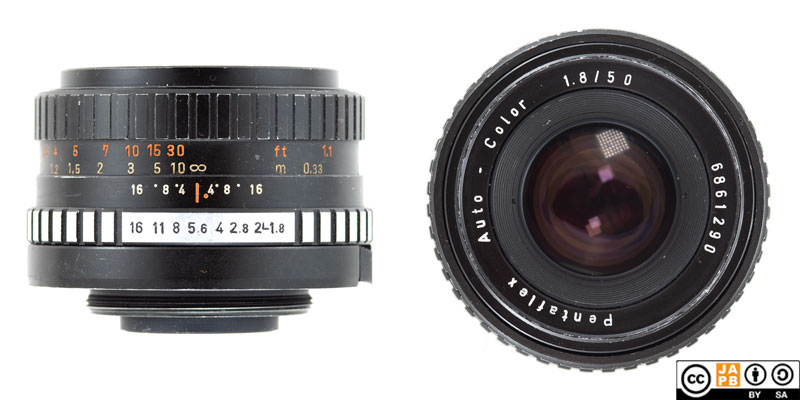
Do you know of Pentaflex cameras and lenses I have not mentioned? Drop me a line and donate a picture.
Epiogue
In practice Pentaflex became an established name for East German cameras (mostly the Pentacon Praktica Nova that was sold as the Pentaflex SL) and lenses (mostly Meyer-Optik Görlitz lenses) in the United Kingdom (and – to a much lesses degree – some other countries). Specifically this arrangement was relatively short-lived and by the end of the 1960s the Pentaflex name fell out of use.
Footnotes
.